Model · JDM models
Mitsubishi Lancer Evolution IV: history, AYC and what to check
A new body, a 280 PS 4G63 and an electronic system that steers the car with the rear wheels' torque. What the Evo IV is, how the GSR and the RS differ, and what to check before buying one.
Published on · 7 min read · TOPRANK Europe
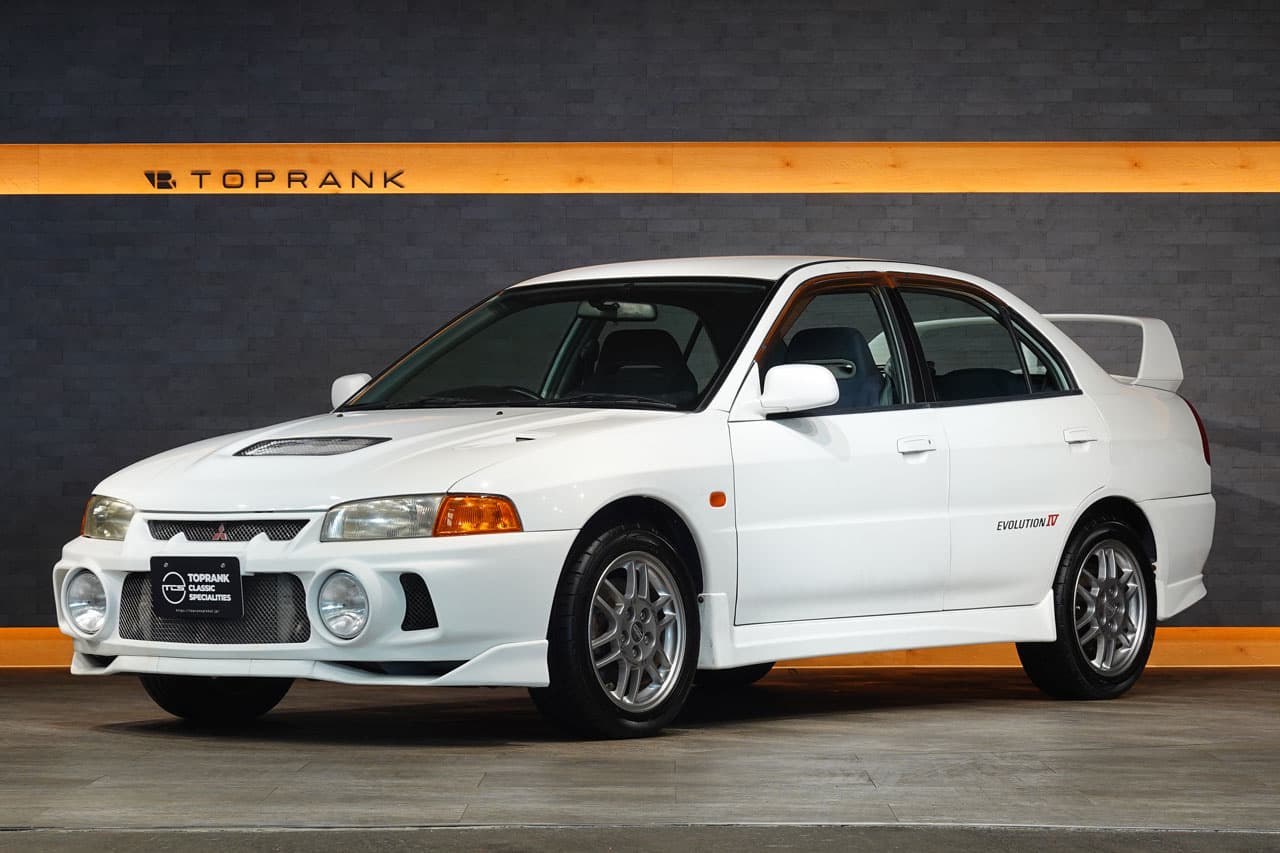
In August 1996, Mitsubishi launched the fourth Lancer Evolution. New body, new rear suspension, an engine turned around, and a system that no Evolution had before: Active Yaw Control, or AYC. The following year, Tommi Mäkinen won the world rally drivers' title with it.
A new generation
The ordinary Lancer, base of the Evolution, was fully renewed in October 1995. The Evolution followed: with the Evo IV, the series moved into its second generation. The road car carries the chassis code CN9A.
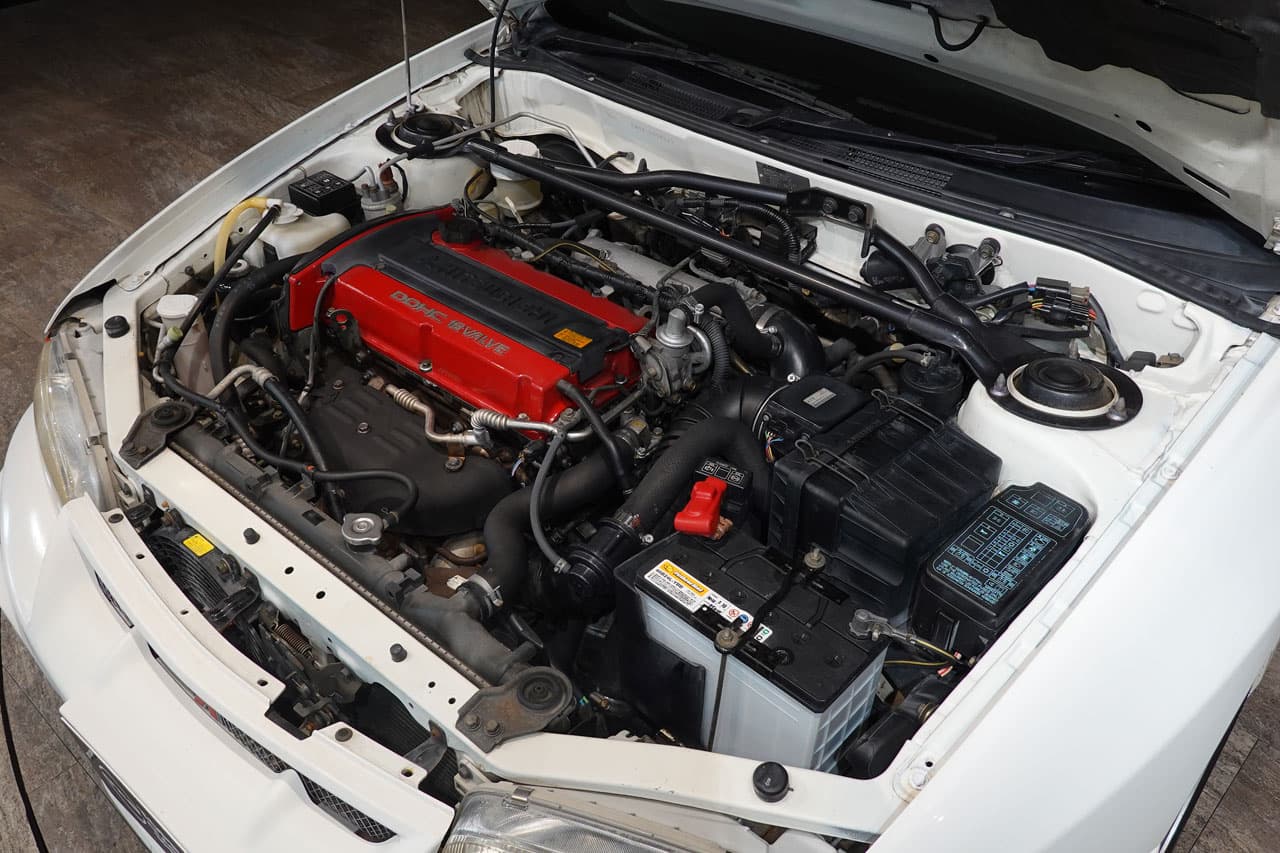
The engine stays the 4G63, a 2.0-litre turbocharged four-cylinder with an intercooler. Mitsubishi gave it a high-speed cam profile, forged pistons and a twin-scroll turbocharger: 10 PS more than before, for 280 PS, the limit Japanese makers held themselves to at the time. The Japanese press notes that the engine is now mounted the other way round compared with the previous model.
| Lancer Evolution IV (1996) | |
|---|---|
| Chassis code | CN9A |
| Engine | 4G63, 2.0-litre four-cylinder, turbo and intercooler, 1,997 cc |
| Power | 280 PS (official) |
| Torque | 36.0 kgm at 3,000 rpm, about 353 Nm (listing of a GSR at TOPRANK) |
| Gearbox | 5-speed manual |
| Rear suspension | New multi-link design |
| Size | 4,330 × 1,690 × 1,415 mm |
| Weight | 1,260 to 1,350 kg depending on version (Japanese catalogue data) |
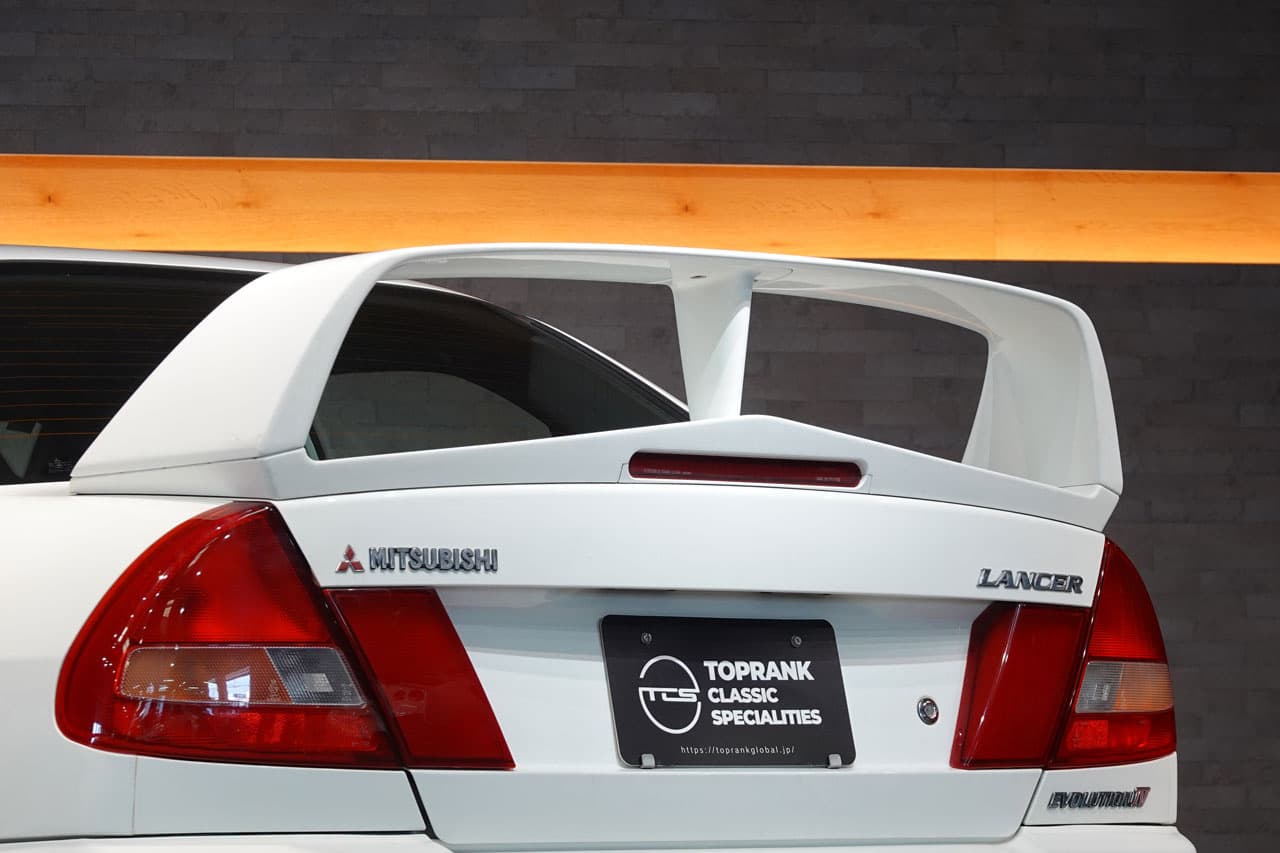
AYC, explained simply
A normal differential lets the two rear wheels turn at different speeds. AYC goes further: it changes the driving force between the left and the right rear wheel. In a corner, it sends more force to the outside wheel. The car turns in more easily, and Mitsubishi also credits it with more stability under braking.
Mitsubishi's own story of the system says AYC was developed in 1996, fitted to the GSR, and offered as an option on the RS. It was not used in the rally cars: in motor sport, durability was still an issue. The same year, Mitsubishi also fitted AYC to some versions of the new Galant. It was then developed through the following Evolutions, up to the Super AYC of the Evo VIII.
GSR or RS
- RS: the base for competition. Mitsubishi equipped it to meet the requests of its works rally team. It could be ordered with a super close-ratio gearbox, in a high or a low version. AYC was an option.
- GSR: the road version, with AYC and more comfort equipment, built so that ordinary drivers could use the car's performance with confidence.
According to the Japanese press, the prices when new were ¥2,998,000 for the GSR and ¥2,498,000 for the RS. The same source gives 13,134 cars sold, the highest figure of any Evolution. Mitsubishi does not publish this figure on its site.
The rally background
Tommi Mäkinen won four world drivers' titles in a row with Mitsubishi, from 1996 to 1999. Each title came with a different car:
- 1996: the title was won with the Lancer Evolution III.
- 1997: the Group A Evolution IV. Mäkinen won Portugal, Catalunya, Argentina and Finland, and took the drivers' title.
- 1998: the Evo IV started the season, at Monte Carlo. The Evolution V arrived at round five, in Catalunya. Mäkinen won his third title, and Mitsubishi its first manufacturers' title.
- 1999: a fourth drivers' title for Mäkinen.
In 1997, rivals moved to the new World Rally Car rules. Mitsubishi stayed in Group A, a category built on production cars. That is why the road Evolution and the rally car stayed so close.
What to check before buying one
The youngest Evo IV is close to 30 years old, and many were driven hard. Check:
- Identity: chassis number CN9A, version (GSR or RS), and whether AYC is fitted. An RS with the options can look like a GSR.
- AYC and warning lights: no warning light should stay on after starting. Ask for the service history of the AYC system, and for any repair.
- Body: underside, sills, wheel arches, mounting points and repaired areas. Ask for photos from underneath.
- Engine and turbo: cold start, temperature, leaks, and invoices for any engine or turbo work. Ask when the timing belt was last changed.
- Drivetrain: gearbox, clutch, differentials, and tyres of the same model on all four wheels.
- Modifications: a list of parts, the engine settings, and the invoices. Check that what is advertised is what is fitted.
- Mileage: it must agree with the invoices and the inspection documents.
In Japan, a car bought from the trade auctions comes with an inspection sheet. It helps, but it does not replace these checks.
Read: the history of a Japanese car
Importing an Evo IV into Europe
An Evo IV built in 1996 reaches 30 years in 2026. In France, a car of that age can apply for collector status if its type is no longer produced and if its technical characteristics have not been modified. In Germany, the same age gives access to the H plate, with an expert report on its original condition.
Age alone is not enough: a modified Evolution may have to go through another route, an individual approval. We tell you which route applies before you buy.
Questions and answers
Was the Evo IV the first car with AYC?
It was the first Lancer Evolution with AYC. Mitsubishi's history also lists AYC on some versions of the Galant launched the same month, August 1996. We therefore do not call either of them the first.
Was the 1997 title won with AYC?
No. According to Mitsubishi, AYC was not used in competition at the time.
Is the Evo IV right-hand drive?
Yes. The Evo IV was made for the Japanese market.
Can TOPRANK find one in Japan?
Yes. TOPRANK Japan buys the car in its own name and exports it; TOPRANK Europe supports you and handles the homologation from Colmar.
Sources
The facts in this article come from the sources below.
- Mitsubishi Motors — Car history: Lancer Evolution IV (1996) and Lancer Evolution V (1998)
- Mitsubishi Motors — Car history, Japanese version (Lancer Evolution IV, 1997 WRC results)
- Mitsubishi Motors — Our latest four-wheel control technology (AYC story)
- Mitsubishi Motors — WRC 1996
- Mitsubishi Motors — WRC 1997
- Mitsubishi Motors — WRC 1998
- TOPRANK Global — 1996 Lancer GSR Evolution IV (listing 109242)
- Kuruma News — Lancer Evolution IV (Japanese, August 2020)
- Kuruma News — Mitsubishi Lancer Evolution IV: Evo's best-selling model
- Response — Lancer Evolution IV catalogue entry (Japanese)
- Service-public.fr — véhicule de collection
Keep reading
Your plans
A question about your car?
Tell us what you are looking for. We answer in French, English or German.