Model · JDM models
Subaru Impreza WRX STI (GDB, 2004): what sets the Japanese version apart
A 2.0-litre engine in Japan, a 2.5-litre in the United States, a lighter Spec C sold at home. What the 2004 WRX STI is, how the Japanese car differs, and what to check before importing one.
Published on · 7 min read · TOPRANK Europe
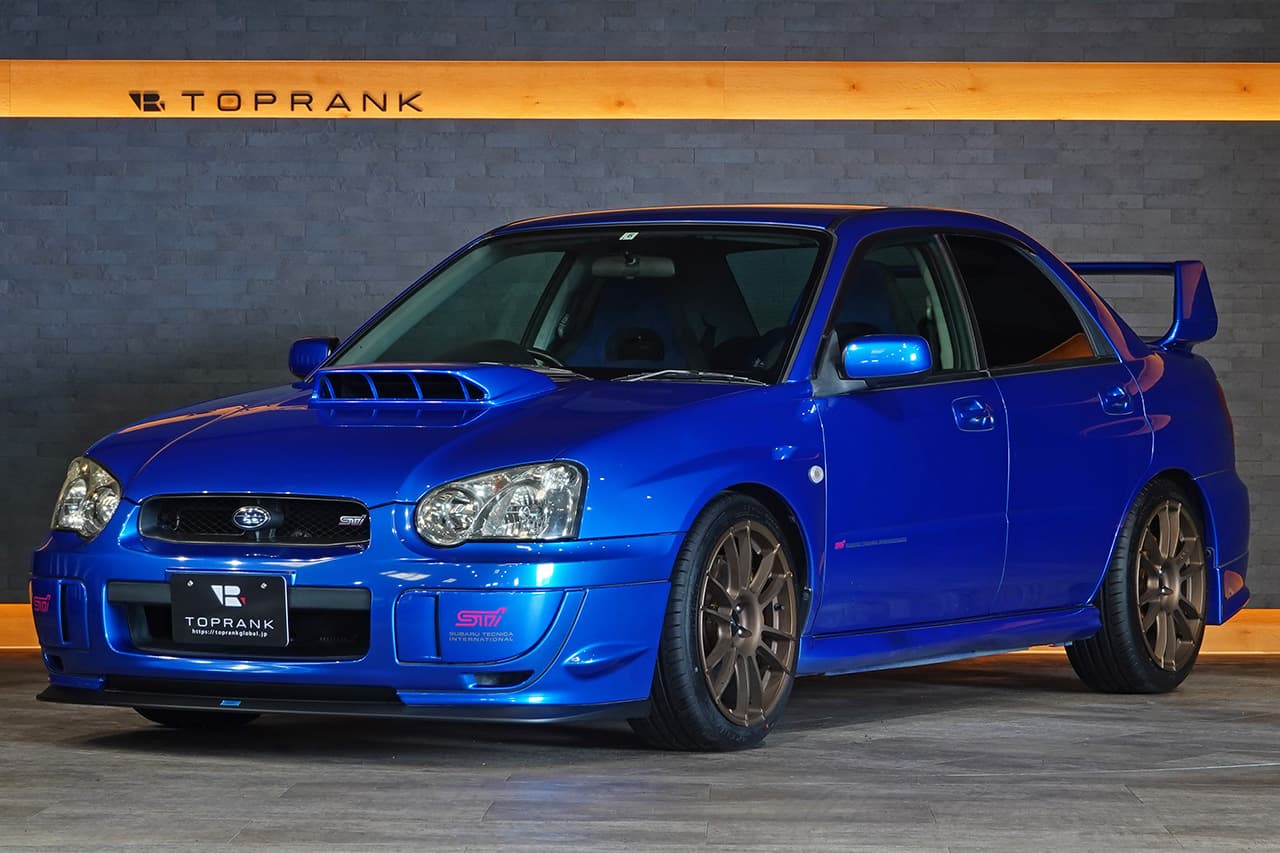
The second Impreza arrived in Japan in August 2000. Two months later came its sharpest version, the WRX STi, named after STI, Subaru's motor sport branch, founded in 1988. Its chassis code, GDB, is the name most buyers use today. This article looks at the 2004 car, and at what makes the Japanese version different from the ones sold elsewhere.
The GDB in a few dates
- October 2000: the STi models arrive, with a new high-rigidity six-speed manual gearbox, a specific engine and inverted strut suspension.
- November 2002: Subaru redesigns the front of the car. This is the face of the 2004 models.
- June 2005: a new grille inspired by aircraft wings, the last major change before the next generation in 2007.
Enthusiasts give each face a nickname. The 2002 to 2005 version is often called Blob Eye. It is not a Subaru name, but you will see it in listings.
The Japanese 2004 WRX STI
| WRX STI | WRX STI Spec C (17-inch) | |
|---|---|---|
| Model code | GH-GDB | GH-GDB |
| Engine | EJ20, 2.0-litre turbo flat four, 1,994 cc | Same |
| Power | 280 PS at 6,400 rpm | 280 PS at 6,400 rpm |
| Torque | 412 Nm at 4,400 rpm | 412 Nm at 4,400 rpm |
| Gearbox | 6-speed manual | 6-speed manual |
| Drive | Full-time four-wheel drive | Full-time four-wheel drive |
| Weight | 1,460 kg | 1,370 kg |
| Size | 4,415 × 1,740 × 1,425 mm | 4,415 × 1,740 × 1,425 mm |
The 280 PS figure is the limit Japanese makers held themselves to at the time. The Japanese catalogue calls the engine EJ20; English-language sources usually give its detailed code, EJ207.
Japan, the United States, Europe: three different cars
- Japan: the 2.0-litre EJ20, at 280 PS, and the choice of a Spec C.
- United States: the 2004 model year is the first STi sold there. Subaru of America announced a 2.5-litre turbo engine with 300 hp and 300 lb-ft, which it described as exclusive to North America. Its detailed code is usually given as EJ257.
- Europe and other markets: according to the sources we consulted, the 2.0-litre engine stayed, with outputs that vary from one market to another.
In other words, a 2.5-litre STi from 2004 is a North American car. A Japanese 2004 STi has the 2.0-litre engine, right-hand drive and Japanese equipment.
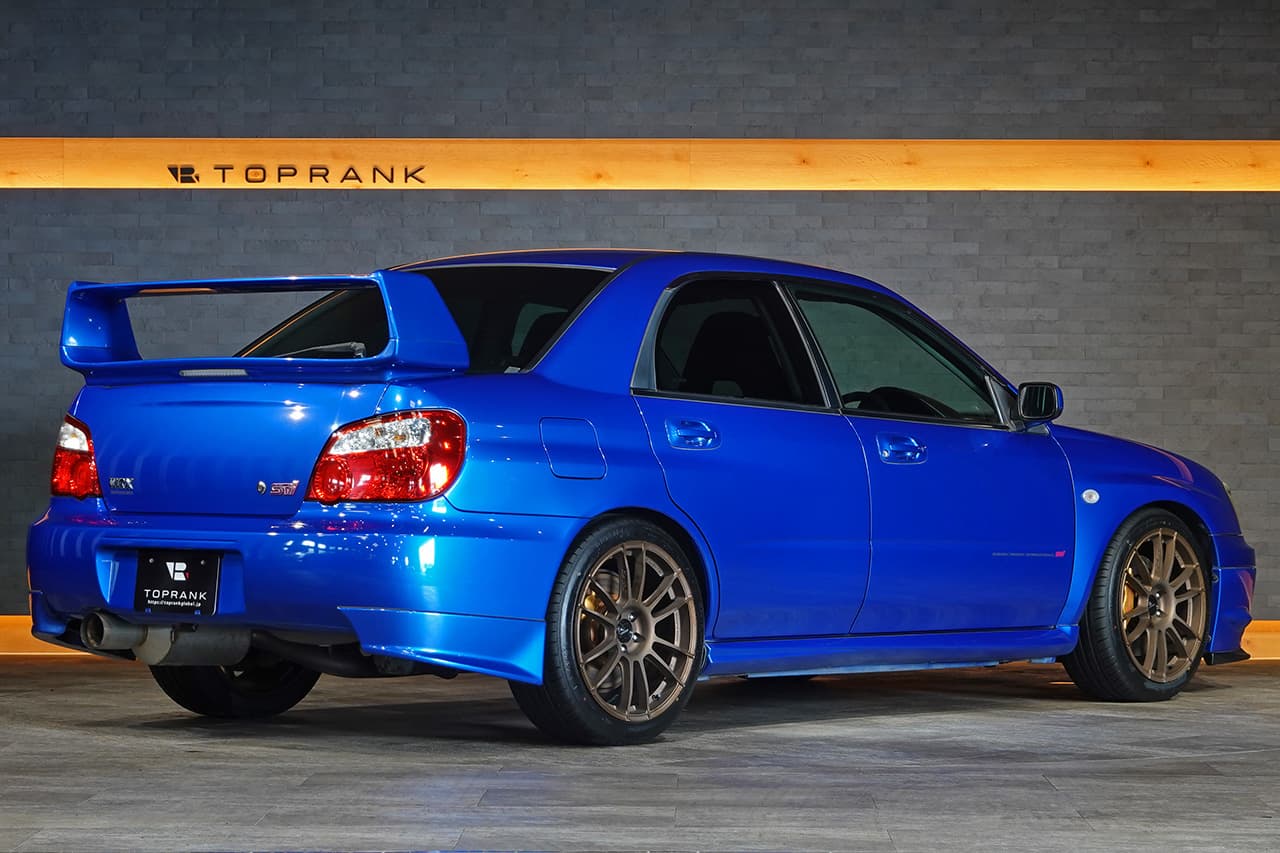
DCCD, explained simply
DCCD stands for Driver Controlled Center Differential. Subaru introduced it in 1994, on the Impreza WRX Type RA STI. The driver can change how the torque is shared between the front and the rear wheels, to suit the road or the surface. Subaru of America lists DCCD on its 2004 STi.
The system changed over the years: according to the sources we consulted, it was adapted to work with the ABS around 2003, and its torque split changed in 2005. On a given car, check on the documents and on the car that the system is fitted and works.
Spec C: the lighter one
The Spec C took over from the Type RA as the version closest to competition. It was sold in Japan. In the June 2004 Japanese catalogue, it came with 16-inch or 17-inch wheels, and the 17-inch Spec C weighs 1,370 kg against 1,460 kg for the standard WRX STI.
According to English-language sources, the weight saving comes from lighter glass and body panels, and the Spec C also has quicker steering. We have not found an official Subaru list of its differences, so check the specification of each car.
The rally years
Subaru competed in the World Rally Championship from 1990, with the Impreza from 1993. Its drivers won the world title three times: Colin McRae in 1995, Richard Burns in 2001 and Petter Solberg in 2003. In 2005, Toshihiro Arai won the production car championship (PCWRC).
What to check before buying one
- Identity: model code GH-GDB, version (WRX STI or Spec C), and the yearly update letter (the applied model) on the identification plate.
- Modifications: many GDBs have been modified. Ask for a list of parts and invoices, and check that what is advertised is what is fitted.
- Engine and turbo: cold start, smoke, leaks, temperature and invoices for any engine work.
- Drivetrain: clutch, six-speed gearbox, differentials and DCCD. Tyres of the same model and wear on all four wheels.
- Body: underside, sills, wheel arches, signs of repair or of competition use.
- Wheels: according to the sources we consulted, the wheel bolt pattern changed in 2005, from 5 × 100 to 5 × 114.3. A 2004 car keeps the first one.
- History: mileage that agrees with the invoices and the inspection documents.
Importing a 2004 STI into Europe
A 2004 car is about 22 years old. It is too young for collector status in France or the H plate in Germany, which start at 30 years. It goes through an individual approval: with the DREAL in France, or a TÜV individual approval (§21) in Germany.
A car built for Japan always needs some work, for example a rear fog light on the left side and headlights approved for Europe. Modifications must also be accepted. We tell you which route applies, and what it involves, before you buy.
Questions and answers
Does a Japanese 2004 STI have the 2.5-litre engine?
No. In Japan, the 2004 WRX STI has the 2.0-litre EJ20. The 2.5-litre belongs to the North American cars.
Is Blob Eye an official name?
No. It is a nickname used by enthusiasts for the face of 2002 to 2005.
Can a Spec C be registered in Europe?
It follows the same individual approval as any Japanese car of its age. The result depends on the car and its condition: we review each file before you commit.
Can TOPRANK find one in Japan?
Yes. TOPRANK Japan buys the car in its own name and exports it; TOPRANK Europe supports you and handles the homologation from Colmar.
Sources
The facts in this article come from the sources below.
- SUBARU — WEB Cartopia, the history of the WRX (Japanese, August 2026)
- Subaru of America — Subaru marks STI 30th anniversary (April 2018)
- Subaru of America — 2004 Impreza WRX STi at the North American International Auto Show (January 2003, reproduced by conceptcarz)
- Kurumaerabi — catalogue data, WRX STI, June 2004 (Japanese)
- Kurumaerabi — catalogue data, WRX STI Spec C 17-inch, June 2004 (Japanese)
- Wikipedia — Subaru Impreza (second generation)
- Auto Bild — Subaru Impreza WRX STi Spec C (German)
- TOPRANK Global — 2003 Subaru Impreza WRX STI GDB (listing 100028)
Keep reading
Your plans
A question about your car?
Tell us what you are looking for. We answer in French, English or German.