Guide · Buying and importing
No invoices, masked names: how to read the history of a Japanese car
A car from Japan rarely comes with a folder of invoices, and the owner's name is hidden. That is not a warning sign. Here is what proves the history instead.
Published on · 8 min read · TOPRANK Europe
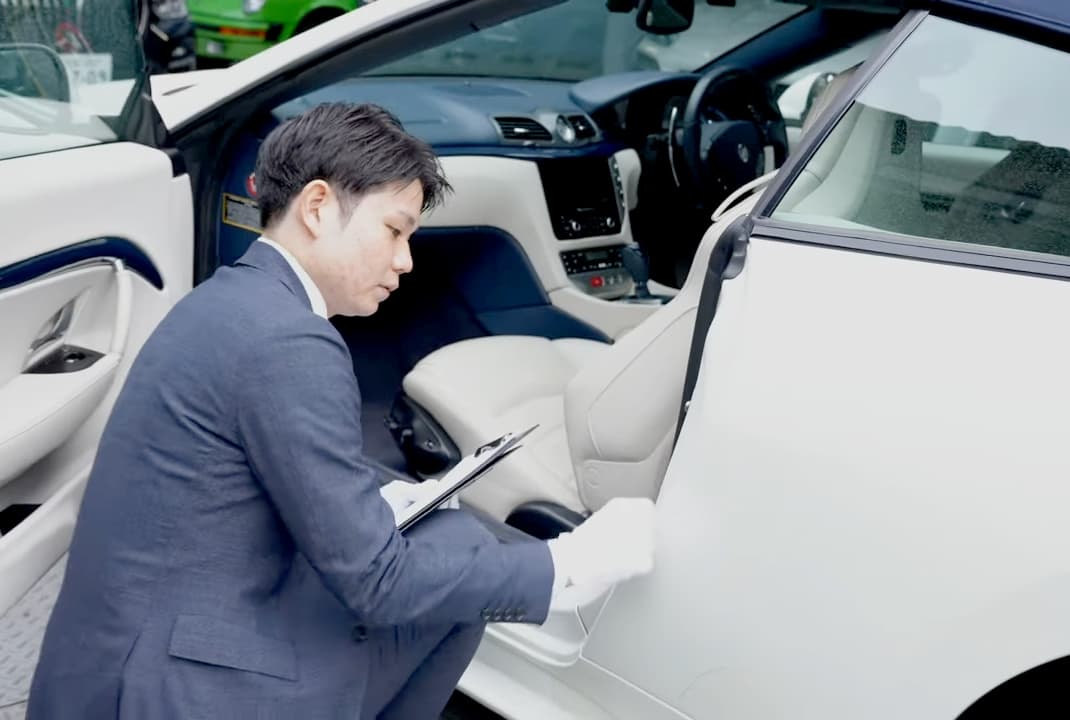
In Europe, a well-kept car is sold with a thick folder: every invoice since new. Buyers who look at a Japanese car for the first time search for that folder and do not find it. They also see black bars over the owner's name. Both have simple reasons.
Shaken: the inspection every car must pass
In Japan, a private car has its first compulsory inspection three years after its first registration, then every two years. This inspection is called shaken. It checks the identity of the car, the brakes, the wheel alignment, the speedometer, the headlights and the exhaust emissions.
The law adds periodic maintenance: a 29-point check every year and a 60-point check every two years. Each one is written in a maintenance record book, which must be kept in the car. The legal minimum is to keep it for two years. The ministry advises keeping it for the life of the car.
Each shaken also has a cost set by the state: a weight tax, paid for two years. For a car up to 1.5 tonnes, it is ¥24,600. It rises to ¥34,200 once the car is 13 years old, and to ¥37,800 at 18 years. Keeping an old car on the road in Japan is a choice the owner pays for, every two years.
Why there are no invoices
In our experience, the detailed invoices that European buyers expect are rarely handed over with a Japanese car. The reference document is not the invoice. It is the maintenance record book and the inspection certificate.
What documents exist
- The export certificate. It is issued by the Japanese transport administration when the car is deregistered for export. It gives the chassis number, the engine, and the date of first registration in Japan.
- The maintenance record book, when the previous owner kept it. It lists the periodic checks.
- The auction sheet, when the car was bought at auction. An inspector of the auction house writes it: overall grade, interior and exterior grades, and a diagram of the marks on the body. Each auction house has its own scale.
Mileage: recorded at each inspection
Since 2004, the mileage shown at each inspection has been written on the inspection certificate. The auction houses also share a database of the mileage of the cars that pass through their halls. The export certificate generally carries the mileage recorded at the last inspections, with their dates.
Japanese dealers follow a display code. A replaced odometer must be declared, with the mileage before and after. A car whose odometer was tampered with must be shown as such. When the mileage is doubtful, the dealer must display a question mark.
Why the owner's name is masked
A name and an address identify a person. Japanese law forbids a business to give personal data to a third party without the person's consent. On the European side, the GDPR applies to any company established in the European Union, even when the person lives in Japan. It also requires that only the necessary data be shown.
A buyer needs the chassis number, the dates and the mileage. A buyer does not need the name and address of the person who owned the car in Osaka. So on the copies we publish or send before a sale, names and addresses are masked. The originals stay complete: customs and the registration authorities need them.
Why Japanese cars are often in good condition
- The inspections above. A car that does not pass cannot stay on the road.
- Low mileage. In a 2025 survey by a Japanese insurer, drivers reported 6,728 km a year on average.
- A parking space is compulsory. To register a car, the owner must prove to the police that a parking space off the street is available, within 2 km.
- Speed limits. 60 km/h on ordinary roads and 100 km/h on motorways, up to 120 km/h on a few sections.
None of this proves that a given car is good. It explains why many are.
The honest limits
- Rust. In the snowy regions, salt is spread on the roads. A car that lived there, or by the sea, can be corroded underneath. Photos of the underbody matter more than the mileage.
- Repaired accidents. At auction, a car with a repaired structure is graded R, and RA for a light repair, depending on the auction house. These cars exist and are sold as such.
- Age. Rubber, seals, plastics and air conditioning wear with time, even at low mileage. That is what we see in the workshop on cars that are 25 to 30 years old.
What to ask before you buy
- The export certificate, or the registration document if the car is still registered in Japan.
- The auction sheet, translated, if the car comes from an auction.
- The maintenance record book, if it exists.
- Photos of the underbody, the wheel arches and the sills.
- The region where the car was registered.
For the cars we source in Japan, we translate the documents and explain each car before you decide.
Sources
The facts in this article come from the sources below.
- MLIT (Japanese Ministry of Transport) — validity periods of the vehicle inspection
- MLIT — statutory periodic inspections and the maintenance record book
- MLIT — weight tax table (1 May 2026)
- Japan — Act on the Protection of Personal Information (English translation)
- CNIL — GDPR, chapter 1 (articles 3 and 4)
- EUR-Lex — GDPR, Regulation (EU) 2016/679
- Tokyo Metropolitan Police — parking space certificate, conditions
Keep reading


Your plans
A question about your car?
Tell us what you are looking for. We answer in French, English or German.