Model · JDM models
Mazda RX-7 FD3S: Japanese versions and the compression test
Eleven years of production, a twin-rotor engine with two turbos, and many versions sold only in Japan. What the FD3S is, which versions exist, and why a compression test matters more than the mileage.
Published on · 7 min read · TOPRANK Europe
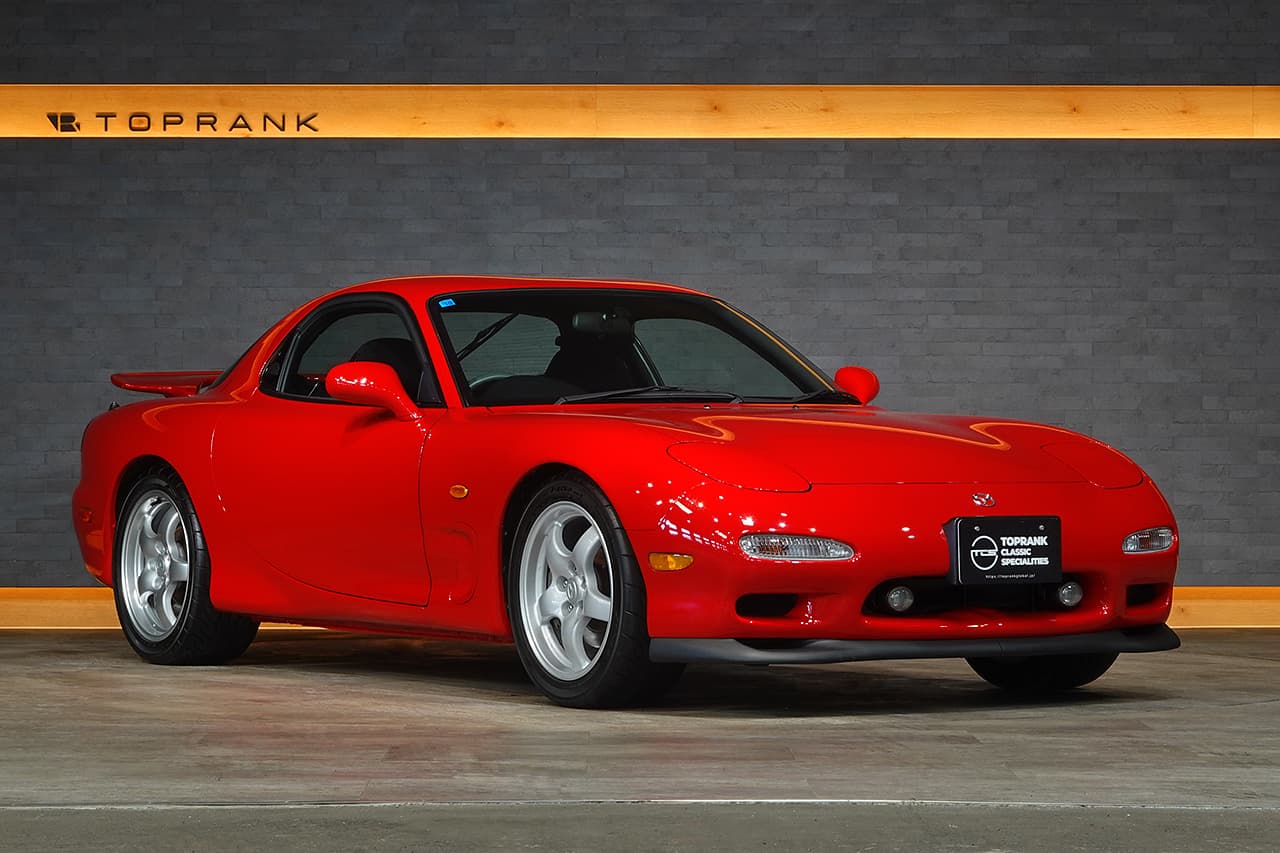
In October 1991, Mazda announced the third RX-7. In Japan it went on sale in December 1991, under the name of Mazda's Efini sales channel. Its chassis code is FD3S. It stayed in production until 2002, with a rotary engine that no other sports car of the time used.
This article explains what the FD3S is, which Japanese versions we could document, and why a compression test is the first thing to ask for on any rotary engine.
The engine: two rotors, two turbos, one after the other
The engine is the 13B-REW: two rotors of 654 cc each, water-cooled, with two turbochargers. A rotary engine has no pistons and no valves. Each triangular rotor turns in a housing shaped like a pinched oval, and each of its three faces works as a combustion chamber in turn.
The two turbos work in sequence. At low engine speed, one turbo does the work. Higher up, the second one joins in. Mazda USA sums up the aim: more torque low down and more thrust at the top. On a healthy car, PistonHeads describes only a very slight step in power when the second turbo comes in, at about 4,500 rpm.
| RX-7 FD3S at launch (1991) | |
|---|---|
| Engine | 13B-REW, two rotors of 654 cc, sequential twin turbo |
| Power | 255 PS |
| Torque | 30 kgm |
| Weight | 1,270 to 1,280 kg |
Figures from the Japanese magazine Motor-Fan, for the 1991 launch. The power rose later, as the next section shows.
The Japanese versions we could verify
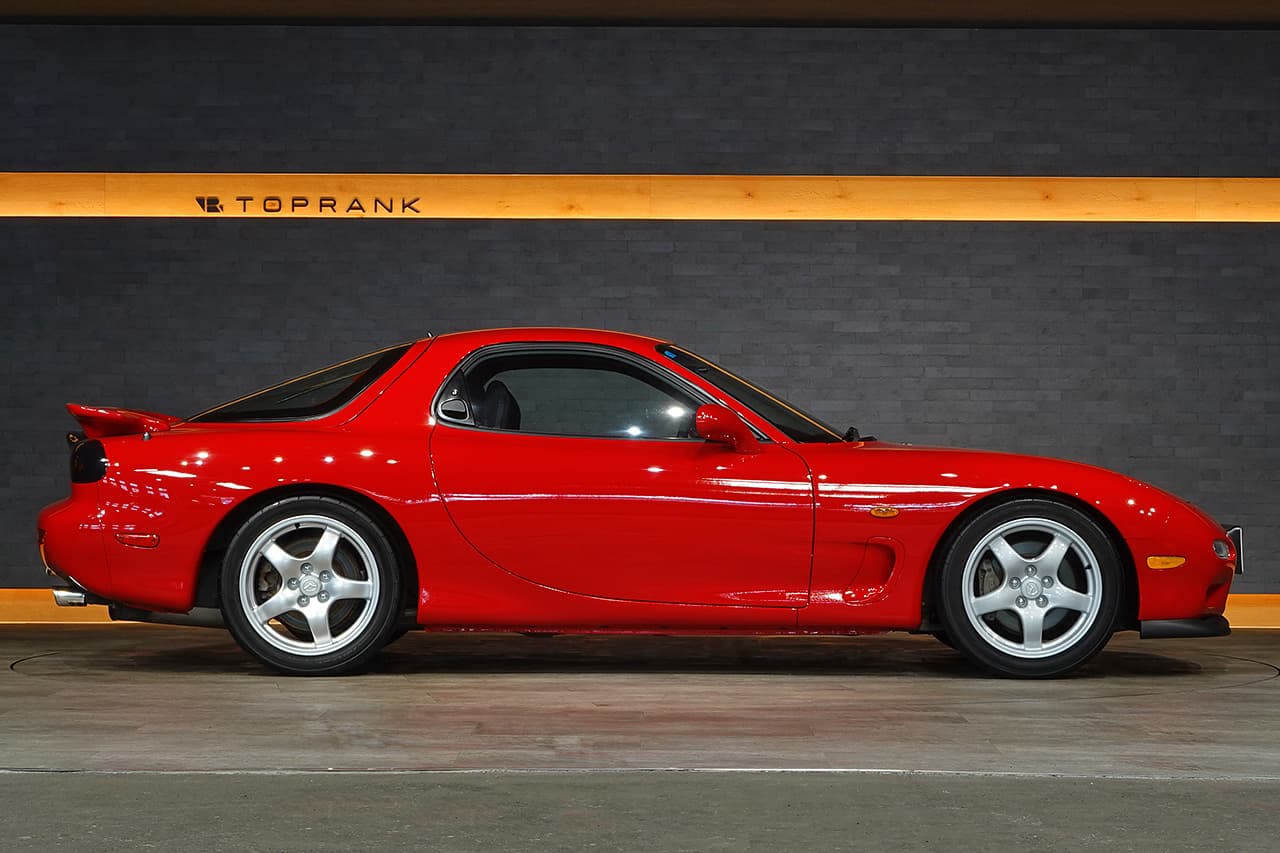
The FD3S changed many times in eleven years, and its grade names changed with it. We only list here the versions whose details we could check in Mazda's own announcements.
- Type RS, Type R and Type RB (announced December 1998, on sale January 1999). The Type RS and Type R reach 280 PS at 6,500 rpm, thanks to more efficient turbos and better cooling. The Type RB makes 265 PS with the manual gearbox, 255 PS with the automatic. The Type RS gets dampers developed with Bilstein. New front bumper and an adjustable rear spoiler on the Type RS and Type R.
- Type RZ (October 2000). A limited edition of 175 cars, based on the Type RS: Recaro bucket seats, Bilstein dampers, BBS wheels, Snow White Pearl Mica paint, about 10 kg lighter than the Type RS. It is a two-seater.
- Spirit R (announced March 2002, on sale April 2002). The final series: 1,500 cars, for Japan only. Type A: two seats, manual, 280 PS. Type B: four seats, manual, 280 PS. Type C: four seats, automatic, 255 PS. Titanium Gray Metallic paint was reserved for the Spirit R.
Other names exist, from earlier years and from other limited series. We have not been able to check their details against a Mazda source, so we do not describe them here. On a given car, the grade is confirmed with the documents, not with a badge or a pair of seats.
Why a compression test matters on a rotary
A piston engine seals its combustion chambers with piston rings. A rotary engine does it with seals: apex seals at the three tips of each rotor, and side seals on its faces. When these seals wear, the chambers leak, the engine loses compression, and it starts badly, idles badly and loses power.
The compression test measures this, chamber by chamber. With two rotors of three faces each, a proper test gives six readings: three for the front rotor, three for the rear rotor. One single number per rotor says much less.
Mazda's procedure for its rotary engines asks for a dedicated rotary tester, a warm engine, a fully charged battery, and a reading of the cranking speed. The reference speed is 250 rpm. When the engine turns faster or slower, the reading is corrected with Mazda's chart. The result is then compared with the values of the workshop manual: a standard value, a minimum, and a maximum difference between chambers and between rotors.
How to read a compression report
- Six readings, with the front and rear rotor clearly named.
- The test conditions: engine warm or cold, cranking speed, units, and whether the figures are raw or corrected.
- The balance: the three chambers of a rotor should be close to each other, and so should the two rotors. A low face on one rotor tells you more than a low average.
- The date and the mileage, especially after a rebuild or a tuning job.
A good result does not tell you everything. It says nothing about the cooling, the ignition, the fuel system or the turbos. It is a starting point, not a certificate.
What else to check on an FD3S
- Heat: the engine bay gets very hot. PistonHeads warns that the turbo control solenoids and the rubber pipes suffer from it. Erratic turbo changeover is a sign.
- Cooling: steam from the exhaust at start-up can point to tired coolant seals. Ask for the coolant service history.
- Oil: a rotary engine uses some oil by design. Check the level often and ask how it was serviced.
- Short cold starts: moving the car a few metres and stopping it can flood the engine. Do not crank it again and again.
- Gearbox: a stiff change between fourth and fifth is a common report on test drives.
- Modifications: many FDs have been modified. A single-turbo conversion is a different engine to assess. Ask who did the work, with which parts and which engine management.
- A rebuilt engine: ask for the invoice, the list of parts and work, the date and the mileage since.
The paperwork matters as much as the car. See how to read the history of a Japanese car.
Read: the history of a Japanese car
Importing an FD3S into Europe
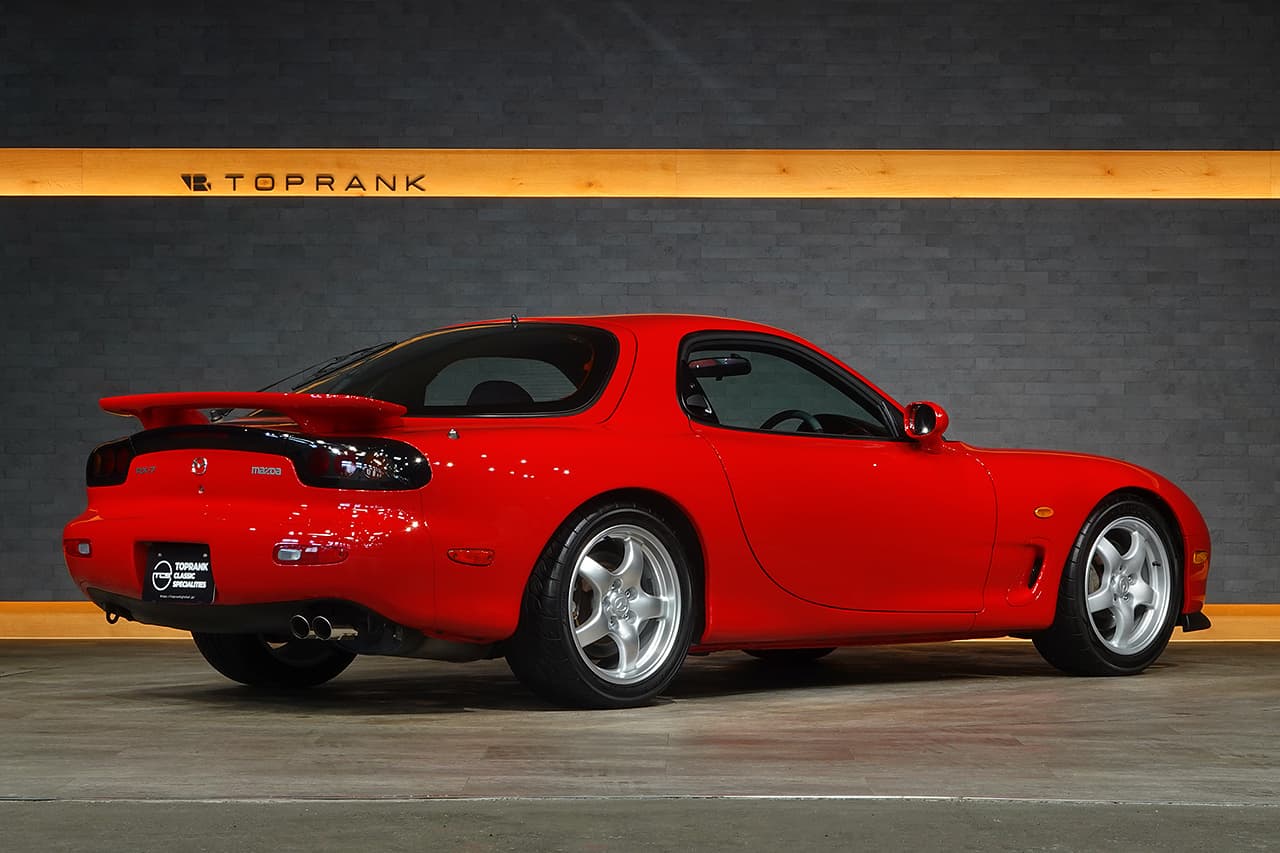
The first FD3S cars turned 30 in 2021; the last ones will in 2032. From the age of 30, a car in original condition can apply for collector status in France and an H plate in Germany. A modified car takes another route. We tell you which one applies before you buy.
Questions and answers
Is a compression test enough to buy an RX-7?
No. It is the first check on the engine, not the only one. Cooling, turbos, body and documents must be checked as well.
Can a seller send me a single compression figure?
You can ask for it, but it is not enough. Ask for the six readings, the cranking speed and the correction applied.
Was the Spirit R sold outside Japan?
Mazda announced it for Japan only, limited to 1,500 cars. A Spirit R in Europe has been imported privately.
Can you find a specific version for me?
Yes. TOPRANK in Japan searches for the car, buys it in its own name and exports it. We support you from Colmar and handle the homologation.
Sources
The facts in this article come from the sources below.
- Mazda newsroom — RX-7 Spirit R, final series (25 March 2002)
- Mazda newsroom — new RX-7 with 280 PS (15 December 1998)
- Mazda newsroom — RX-7 Type RZ (18 October 2000)
- Mazda USA — RX-7 Heaven
- Motor-Fan — third-generation RX-7 (Japanese)
- webCG — Mazda RX-7 Type RZ brief test (Japanese)
- Mazda RX-8 workshop manual — compression inspection (rotary procedure)
- PistonHeads — Mazda RX-7 buying guide: powertrain
- TOPRANK Global — 1998 Mazda RX-7 Type RS (listing 106263)
Keep reading


Your plans
A question about your car?
Tell us what you are looking for. We answer in French, English or German.