Model · JDM models
Honda NSX NA1: the first-generation NSX explained
An aluminium body, a 3.0-litre VTEC V6 and fifteen years of quiet changes. What NA1 means, how the Japanese cars differ, and what to check before buying one.
Published on · 7 min read · TOPRANK Europe
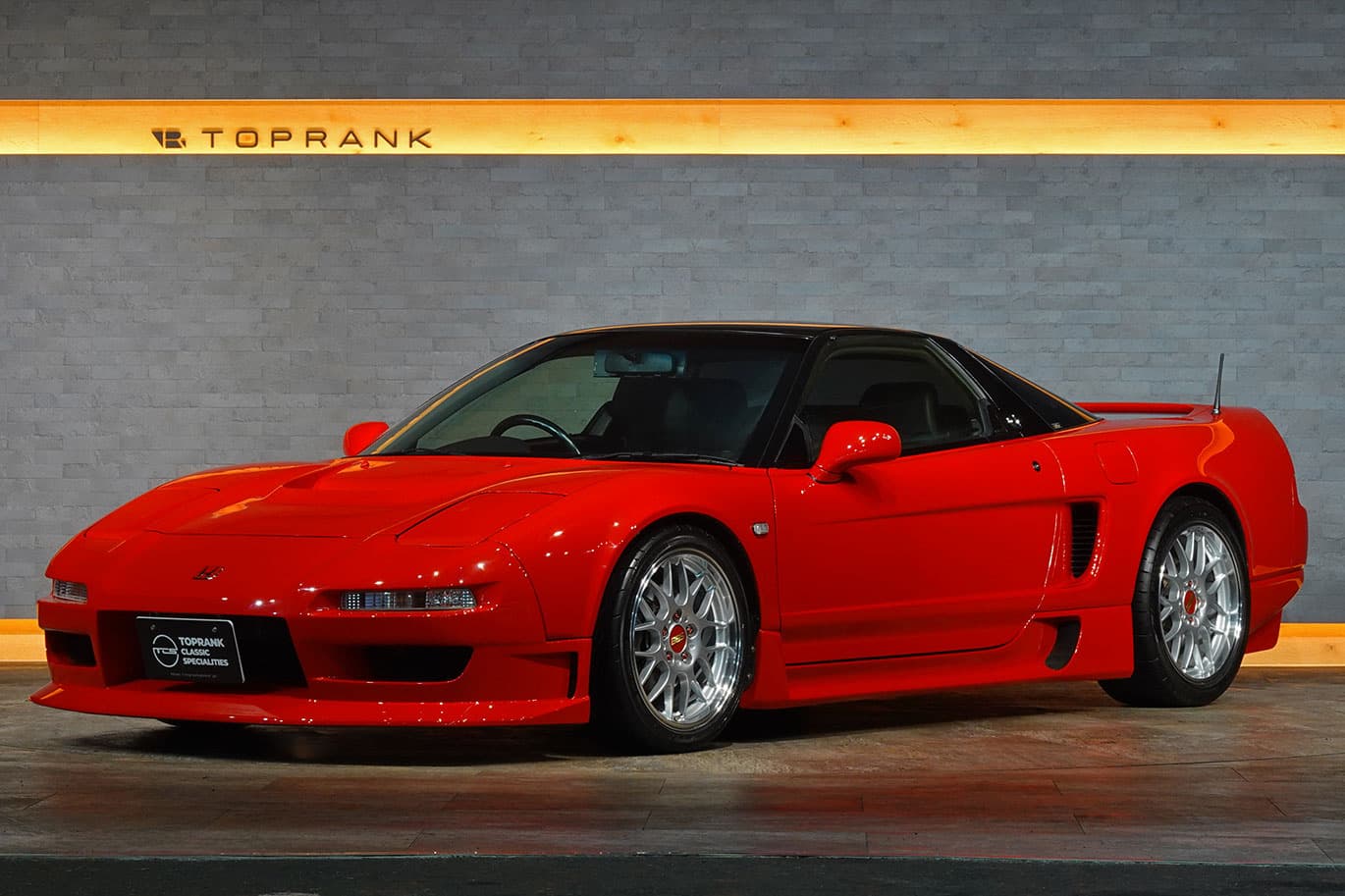
In September 1990, Honda put the NSX on sale in Japan. It was a mid-engined two-seater with a body made almost entirely of aluminium, at a time when no other maker built a production car that way. It stayed in production until 2005, with many changes along the way.
This article covers the car itself: what NA1 means, how a Japanese-market NSX differs, and what to look at before buying one. The lighter Type R versions have their own article.
NA1 and NA2: what the codes mean
NA1 and NA2 are Honda's model codes. On Japanese documents they appear with a prefix, for example E-NA1. The code follows the engine, not the year.
| NA1 | NA2 | |
|---|---|---|
| Engine | C30A, V6 DOHC VTEC, 2,977 cc | C32B, V6 DOHC VTEC, 3,179 cc |
| Gearbox | 5-speed manual or 4-speed automatic | 6-speed manual |
| Power (Honda) | 280 PS at 7,300 rpm (manual), 265 PS at 6,800 rpm (automatic) | 280 PS at 7,300 rpm |
| Torque (Honda) | 30.0 kgm at 5,400 rpm | 31.0 kgm at 5,300 rpm |
| Period | From September 1990 | Manual cars from February 1997 |
In February 1997, Honda enlarged the engine of the manual cars to 3.2 litres and gave them six gears. The automatic kept the 3.0-litre engine and the NA1 code. So an automatic NSX built after 1997 is still an NA1.
An aluminium car, built in its own plant
Honda describes the NSX as the world's first mass-production car with an all-aluminium monocoque body. According to Honda, the aluminium body was 140 kg lighter than a steel one, and the whole car nearly 200 kg lighter.
Building it needed new methods: five aluminium alloys, a new way of forming the sills, and a welding machine developed in-house. Honda built a dedicated plant in Tochigi, finished in May 1990 and designed for about 25 cars a day.
Development included long tests at the Nürburgring. Honda recounts that Ayrton Senna drove a prototype at Suzuka in February 1989 and found it a little fragile. After about eight months of work, the body's rigidity had risen by 50%.
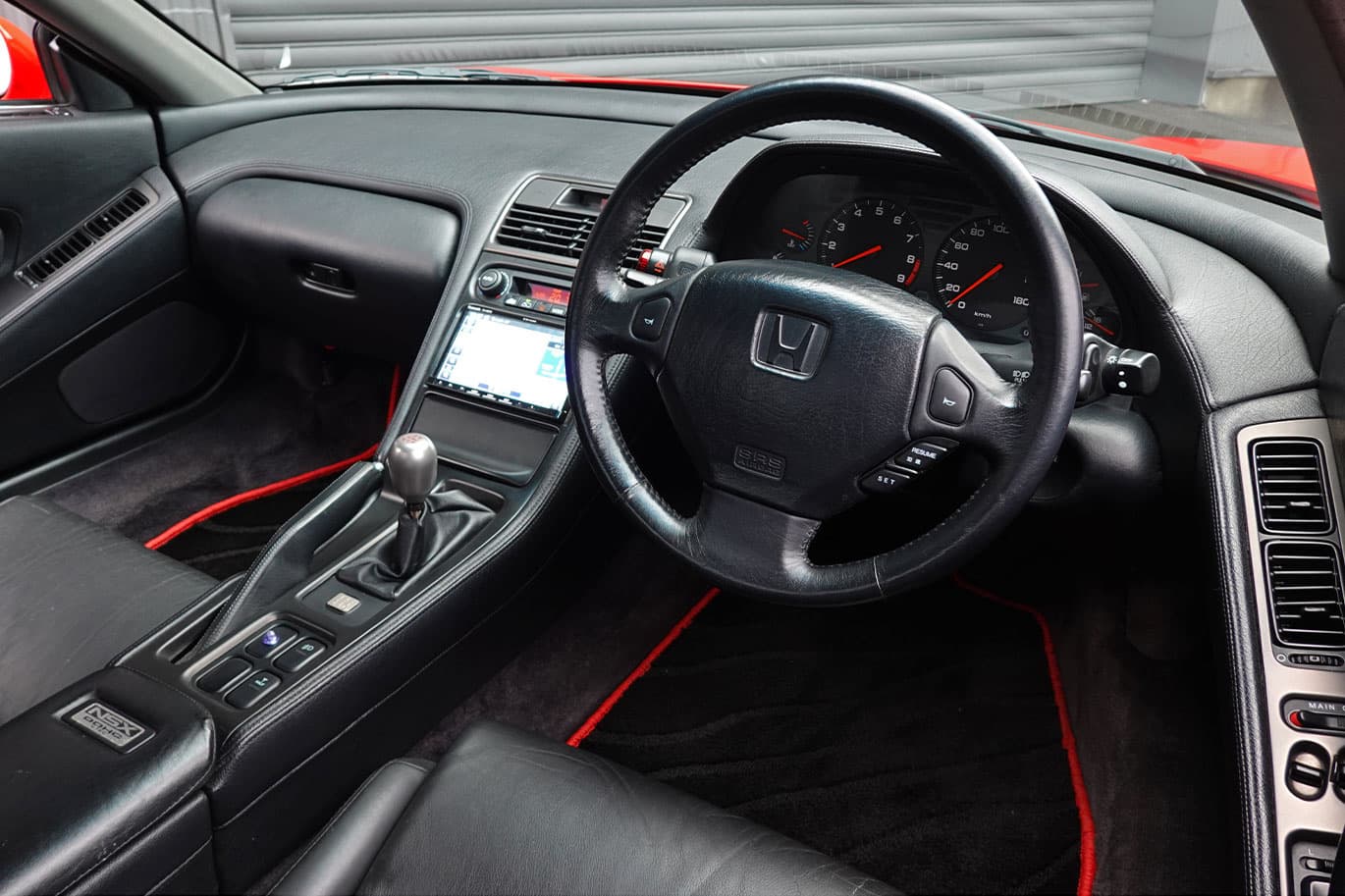
The engine, the C30A, uses titanium connecting rods. Honda says they are about 30% lighter than steel ones and allowed about 700 rpm more. The red zone starts at 8,000 rpm with the manual gearbox, 7,500 rpm with the automatic.
Japanese-market cars
- Honda badge. In Japan and in Europe, the car is a Honda NSX. In North America, it was sold as the Acura NSX, from the summer of 1990.
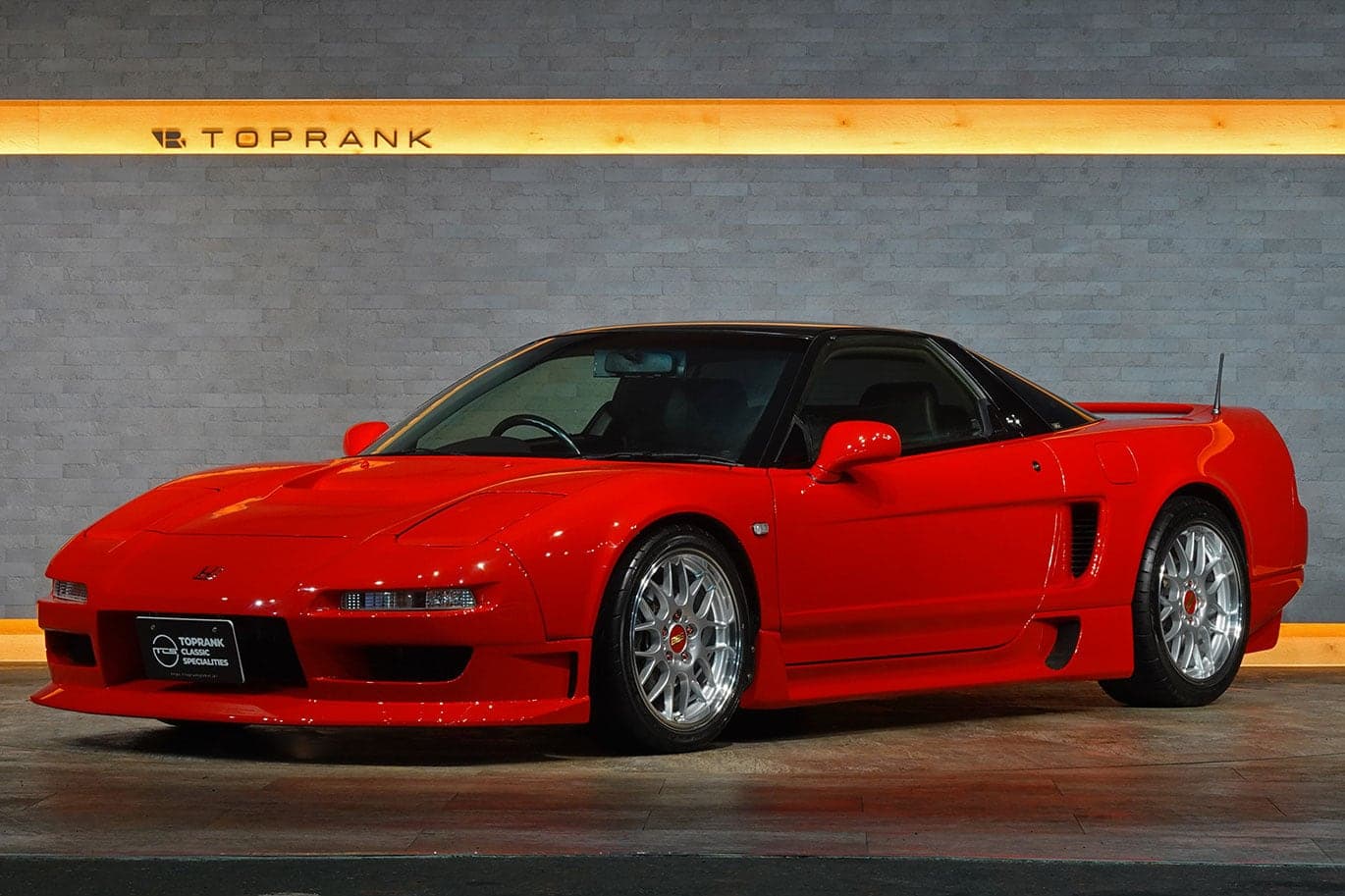
- Right-hand drive. Japan drives on the left, and the Japanese-market cars have the wheel on the right, like the car in the photos.
- Manual or automatic. Both were offered from the start in Japan. From 1995, the automatic gained F-matic, with shift switches next to the steering column.
- Sold through Verno dealers. In Japan, the NSX was sold through Honda's Verno dealer network.
Fifteen years of changes
Honda kept improving the car without changing its shape until 2001. The main dates, from Honda Japan:
| Date | Change |
|---|---|
| 1992 (November) | NSX Type R added |
| 1993 | Passenger airbag. Honda starts its Refresh Plan to restore well-used cars |
| 1994 | 16- and 17-inch tyres, stronger brake pads |
| 1995 (March) | Electronic throttle (drive-by-wire), F-matic automatic, open-top Type T with an 8.5 kg aluminium roof |
| 1997 (February) | 3.2 litres and 6-speed manual (NA2), new type S |
| 1999 | Lower emissions, xenon headlights on every car |
| 2001 (December) | Fixed headlights replace the pop-up ones, 17-inch tyres front and rear |
| 2002 (May) | New NSX-R added |
| 2005 | End of production: September for Europe, December for North America |
Honda says more than 18,000 NSXs were sold worldwide by the end of June 2005.
What to check before buying one
An NA1 is now between about 20 and 36 years old. The buying guides of the specialist press agree on a few points.
- Body: aluminium resists rust better than steel, but damaged panels are expensive and difficult to repair. Look at panel gaps and paint.
- Early manual gearboxes: on some early 5-speed boxes, a snap ring on the countershaft bearing can fail. PistonHeads gives the gearbox numbers J4A4-1003542 to J4A4-1005978, on a sticker on the gearbox. Ask whether the repair was done.
- Timing belt and water pump: the intervals quoted by guides vary. Ask for a dated invoice that names the work.
- Cooling: an NSX has many coolant hoses. Look for leaks and ask when the coolant was last changed.
- Engine mounts and oil leaks: a knock when revving can point to tired mounts. Oil leaks are rare but costly.
- Modifications: many cars have aftermarket parts. Check what is fitted against what is advertised.
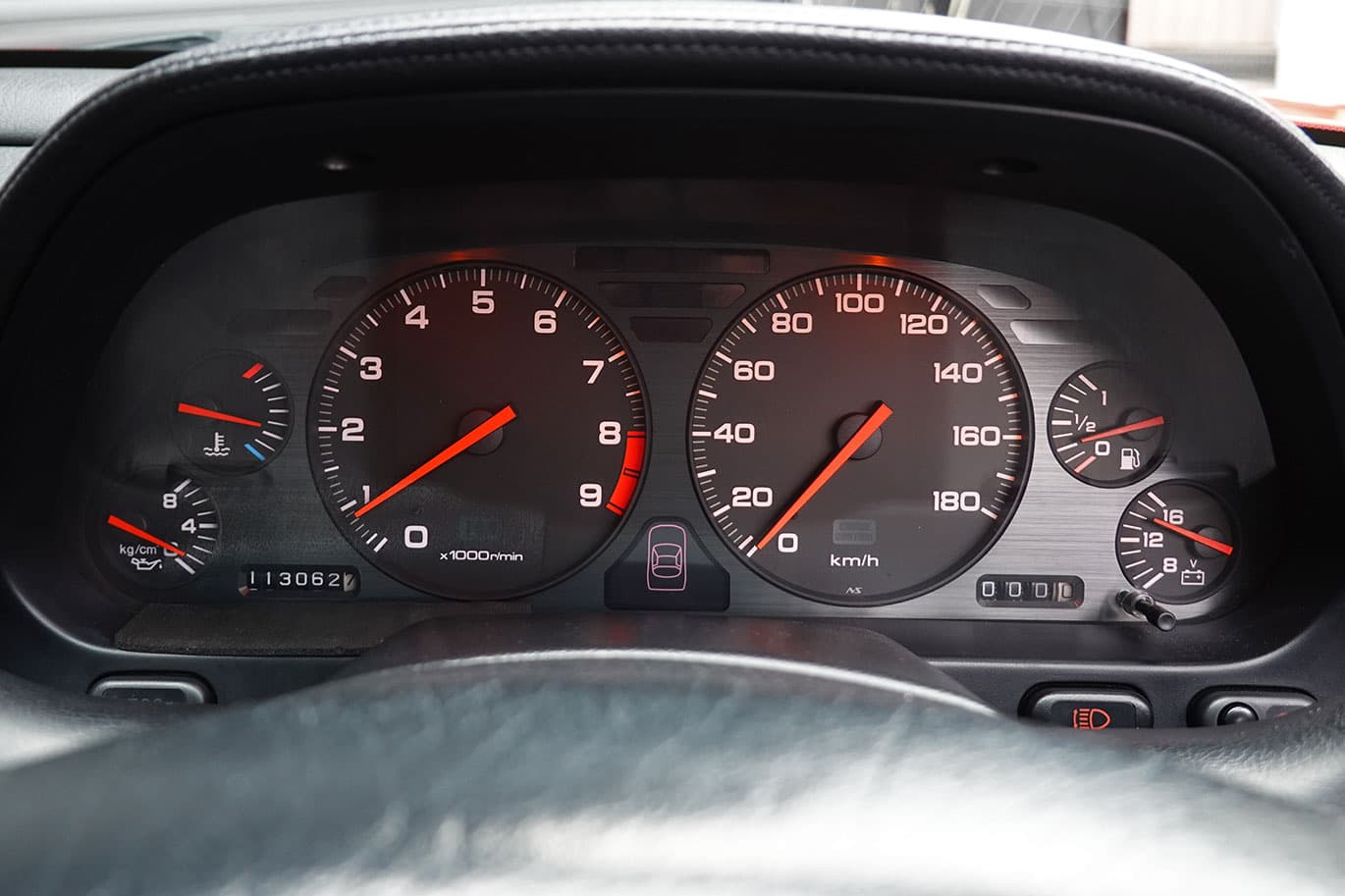
The papers matter as much as the car. A Japanese car comes with inspection records that tell a lot about its life.
Read: the history of a Japanese car
Importing an NA1 into Europe
The earliest NA1 cars are now more than 30 years old. In France, a car of that age can apply for collector status if its type is no longer produced and its technical characteristics have not been modified. In Germany, the same age gives access to the H plate, with an expert report on its original condition.
A younger car, or a modified one, takes another route. TOPRANK Japan buys the car in Japan and exports it. TOPRANK Europe handles the homologation in France or Germany from Colmar, and tells you which route applies before you buy.
Questions and answers
Is a 3.2-litre NSX always an NA2?
Yes. The 3.2-litre engine came with the 6-speed manual in 1997, under the NA2 code. An automatic NSX always has the 3.0-litre engine.
Is a Japanese NSX different from a European one?
The obvious differences are right-hand drive and market-specific equipment. We did not find a Honda source that lists every difference. Check each car's equipment against its documents.
What is the Type T?
An open-top version added in March 1995. Its aluminium roof weighs 8.5 kg and is stored in the rear of the car.
And the NSX-R?
Honda made two of them, in 1992 and in 2002, both much lighter than the standard car. They have their own article.
Sources
The facts in this article come from the sources below.
- Honda Global — The NSX / 1990 (heritage)
- Honda Global — C30A engine (NSX, VTEC DOHC)
- Honda Global — Honda to discontinue production of the NSX (12 July 2005)
- Honda Japan — end of NSX production, history of the model (Japanese)
- Honda Japan — NSX specifications, E-NA1 (Japanese)
- Honda Japan — NSX-T specifications, E-NA2 and E-NA1 (Japanese)
- Honda Japan — NSX Type T, F-matic and DBW (8 March 1995, Japanese)
- Honda Japan — NSX 3.2 litres, 6-speed and type S (6 February 1997, Japanese)
- Honda Japan — NSX, history of the models (Japanese)
- Honda Japan — NSX pressroom, model changes (Japanese)
- PistonHeads — Honda NSX buying guide: powertrain
- Auto Express — Honda NSX Mk1 (1990-2005) icon review
- TOPRANK Global — 1991 Honda NSX NA1 (stock 122732)
- Service-public.fr — véhicule de collection
Keep reading
Your plans
A question about your car?
Tell us what you are looking for. We answer in French, English or German.