Model · JDM models
Toyota Century V12 (GZG50): the limousine Japan kept for itself
A 5.0-litre V12, air suspension and a cabin designed around the rear seat. What the second-generation Toyota Century is, who it was built for, and what to check before importing one.
Published on · 7 min read · TOPRANK Europe
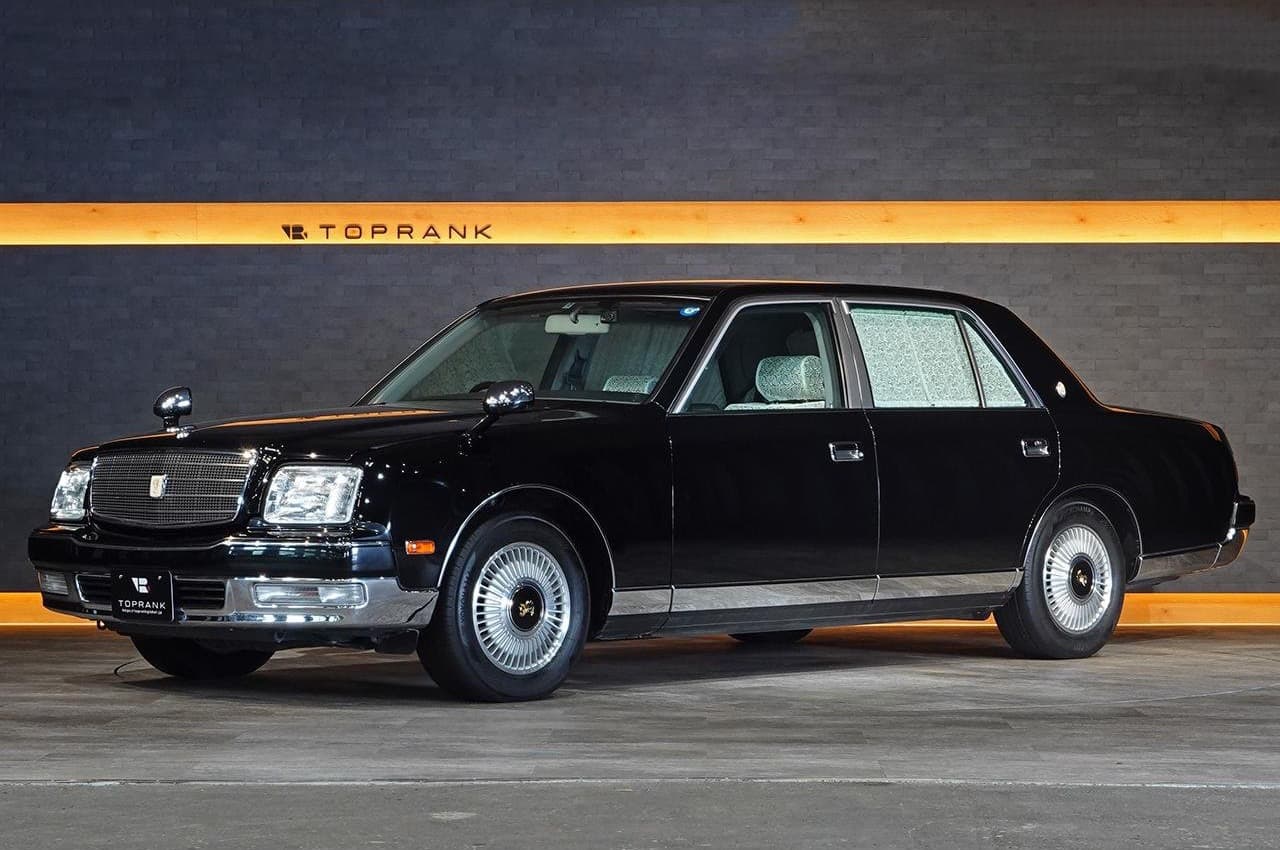
The Toyota Century is the car that Japan's companies and institutions put their passengers in. It is driven by a chauffeur, sold in Japan, and changes very rarely: three generations in more than fifty years. The second generation, code GZG50, is the one with the V12.
A car built for the back seat
Toyota launched the first Century in 1967, to mark the centenary of the birth of Sakichi Toyoda, the founder of the group. In Toyota's own words, the Century has served for more than fifty years as the chauffeur-driven model of choice in Japan, with a cabin made for VIPs.
The second generation arrived on 18 April 1997, thirty years after the first. Toyota kept the formal shape of the car and changed almost everything underneath. The stated goal: relaxation and ride comfort for the passengers. The owner of a Century usually sits in the back.
The 1GZ-FE V12
Toyota describes the 1GZ-FE as the first V12 for a Japanese passenger car. It is a 4,996 cc engine with two banks of six cylinders, four overhead camshafts and 48 valves. It gives 280 PS at 5,200 rpm, the limit Japanese makers held themselves to at the time. The figure that matters in this car is torque, available low in the rev range, for a smooth and quiet ride rather than for speed.
In January 2003, Toyota added a version running on compressed natural gas (CNG), with 258 PS, a 200-litre tank and a range of about 350 km.
| April 1997 | April 2000 | January 2005 | |
|---|---|---|---|
| Model code | E-GZG50 | TA-GZG50 | DBA-GZG50 |
| Power | 280 PS at 5,200 rpm | 280 PS at 5,200 rpm | 280 PS at 5,200 rpm |
| Torque | 480.5 Nm at 4,000 rpm | 481 Nm at 4,000 rpm | 460 Nm at 4,000 rpm |
| Gearbox | 4-speed automatic | 4-speed automatic | 6-speed automatic |
| Weight (version listed) | 1,990 kg | 2,000 kg | 2,050 kg |
The body stays the same throughout: 5,270 mm long, 1,890 mm wide, 1,475 mm high, with a 3,025 mm wheelbase. Rear-wheel drive, electronically controlled air suspension (Toyota calls it Skyhook) and double wishbones at all four wheels.
What makes it different from a European limousine
- Made for one market. The Century was designed and sold for Japan. It is right-hand drive, and its equipment, navigation and radio were made for Japanese users.
- The rear seat comes first. The cabin is arranged around the passengers: powered rear seats and rear climate controls are listed on many cars. Each car is different: check the equipment of the one you are looking at.
- Discretion. No sporting version, no big badge. The design changed very little in twenty years.
- A long career. The GZG50 was followed by the third generation, which Toyota presented in June 2018 as the first full redesign in 21 years. That generation no longer has a V12.
One passed through TOPRANK Europe
A 2005 Century V12 with a six-speed automatic passed through the stock of TOPRANK Europe in Colmar. It is not a common car in Europe, and each one we see is a little different: colour, equipment, use in Japan.
What to check before buying one
A Century is a large, heavy and complex car. Many were used by companies, often with a professional driver. That can mean a regular service history, but also many hours of idling. Check:
- Engine and cooling: service invoices, leaks, warning lights, and behaviour from a cold start to normal temperature.
- Gearbox: which one is fitted (four or six speeds, column or floor shift), its service history, smooth engagement and shifts.
- Air suspension: ride height at rest and after a night parked, warning lights, any conversion or previous repair.
- Body and underside: corrosion, past repairs, tyres and brakes. A 2-tonne car wears them out.
- Cabin: try every seat, window, curtain, climate and audio function. Check the upholstery, the trim and the headlining.
- History: dates and mileage must agree between invoices, inspection documents and registration papers.
- After the purchase: find a workshop able to work on the car, and ask about parts before you buy.
To read the documents of a Japanese car, see our guide on its history and the shaken inspection.
Read: the history of a Japanese car
Importing a Century into Europe
The first GZG50s date from April 1997. In France, collector status is open to cars over 30 years old whose type is no longer produced and whose technical characteristics have not been modified. The oldest GZG50s reach that age from April 2027; most are much younger.
A younger car goes through an individual approval: with the DREAL in France, or a TÜV individual approval (§21) in Germany. A car built for Japan always needs some work: for example a rear fog light on the left side and headlights approved for driving in Europe. We tell you which route applies, and what it involves, before you buy.
Questions and answers
Is the Century the only Japanese car with a V12?
Toyota presents the 1GZ-FE as the first V12 for a Japanese passenger car. We have not found an official Toyota source that says more, so we keep to that wording.
How many were built?
We have not found an official production figure for the GZG50. We prefer not to give an estimate.
Was it ever sold new in Europe?
The Century was designed for the Japanese market. A Century in Europe is, in practice, an imported car.
Can TOPRANK find one in Japan?
Yes. TOPRANK Japan buys the car in its own name and exports it; TOPRANK Europe supports you and handles the homologation in France or Germany from Colmar.
Sources
The facts in this article come from the sources below.
- Toyota — 75 Years of Toyota, vehicle lineage: Century, 2nd generation (April 1997)
- Toyota Global Newsroom — Toyota rolls out first fully redesigned Century in 21 years (June 2018)
- Toyota (toyota.jp) — official catalogue data, Century, April 1997
- Toyota (toyota.jp) — official catalogue data, Century, April 2000
- Toyota (toyota.jp) — official catalogue data, Century floor shift, January 2005
- Toyota (toyota.jp) — official catalogue data, Century floor shift, April 2014
- Service-public.fr — véhicule de collection
Keep reading
Your plans
A question about your car?
Tell us what you are looking for. We answer in French, English or German.