Guide · Buying and importing
RoRo, container or plane: how a car travels from Japan to Europe
Three ways to bring a car from Japan to Europe. What each one is, what it protects, what it does not allow, and what happens at the port.
Published on · 7 min read · TOPRANK Europe
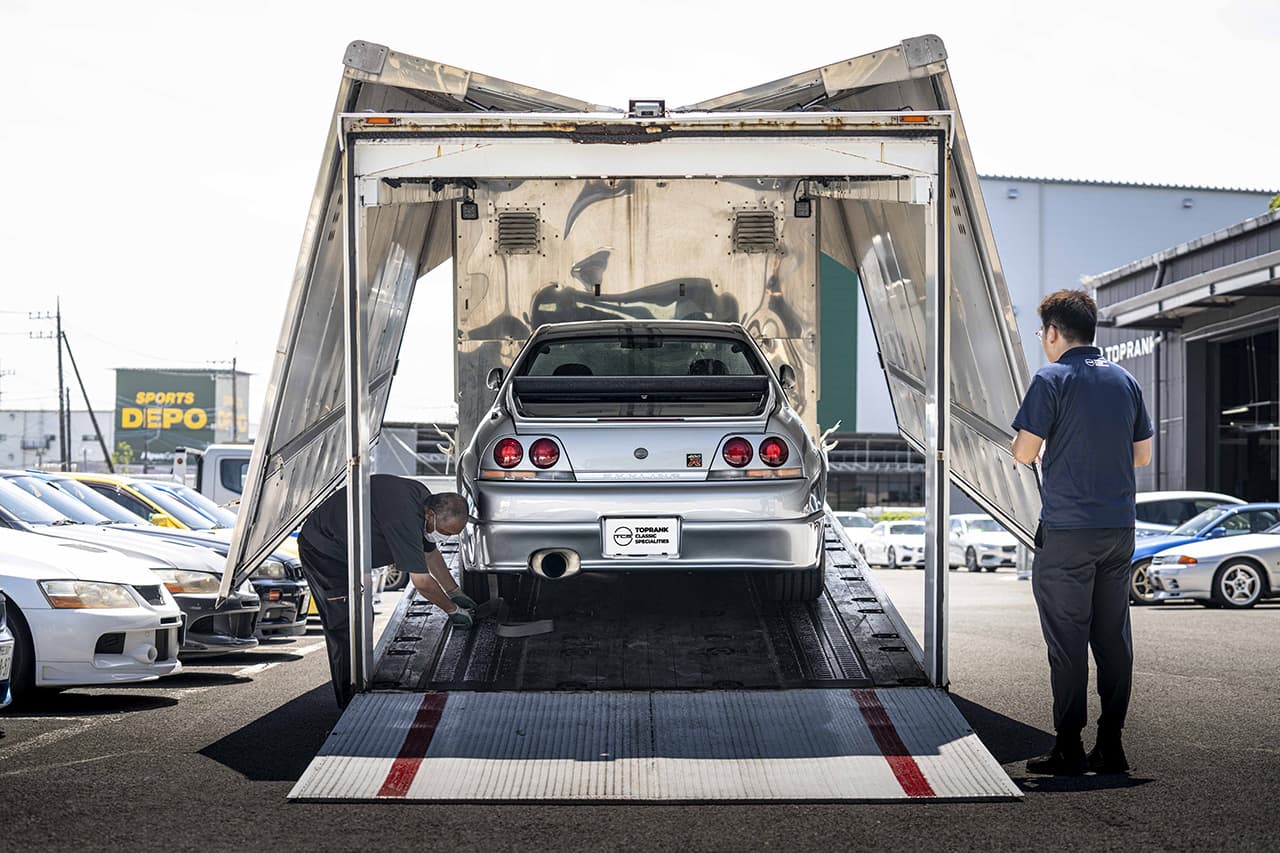
Between a car park in Japan and your garage there is half the planet, most of it sea. A car can cross it in three ways: driven onto a ship, locked in a container, or flown. None is the best in every case. Here is how each one works, and how to choose.
RoRo: the car drives onto the ship
RoRo means roll-on / roll-off. The car is driven up a ramp into a ship built for vehicles, called a PCTC (pure car and truck carrier). It is parked on a covered deck, secured, and driven off at the port of arrival. Nothing is lifted by a crane.
- The upside: it is generally the simplest and least expensive method for a car that runs.
- The car must run: it has to start, steer and brake on its own.
- Nothing inside: personal items and spare parts are generally refused. The car travels as it left the factory.
- Less protection: the car is handled and parked close to others, so the risk of a small mark is higher than in a container.
- Not every port: only some ports handle RoRo ships.
Container: the car travels locked in a steel box
The car is driven or winched into a container. Its wheels are chocked to the floor and strapped to the anchor points. The doors are closed and sealed. A 20-foot container usually takes one car. A 40-foot container takes several, sometimes on racks, and can be shared between owners to split the cost.
- The upside: better protection and security. It is the choice freight forwarders recommend for rare or very valuable cars.
- A car that does not run can travel: it is the only sea option for a non-runner.
- Parts can travel with it, subject to customs rules.
- The downside: it almost always costs more than RoRo, mainly because of port and handling charges.
Air freight: days instead of weeks
The car is fixed on an aircraft pallet or in an aircraft container. The advantage is speed: days instead of weeks. The drawback is the price, which is why air freight is kept for very valuable cars or for a fixed date, such as an event or a race. It is always quoted case by case.
The three methods side by side
| RoRo | Container | Air | |
|---|---|---|---|
| How it travels | Driven on board, parked on a covered deck | Strapped inside a sealed steel container | Fixed on an aircraft pallet |
| Car must run | Yes | No | No |
| Protection | Good | Better | Better |
| Items in the car | Generally refused | Possible, subject to customs | On request |
| Cost level | Lowest in general | Higher | Highest |
| Makes sense for | A car that runs, standard value | Rare or valuable car, non-runner, parts | Very valuable car, fixed deadline |
How long does it take?
Allow several weeks at sea, plus the time before departure and after arrival. Since the end of 2023, a large share of the ships between Asia and Europe sail around the Cape of Good Hope instead of crossing the Red Sea and the Suez Canal. The shipping line Wallenius Wilhelmsen put the detour at 10 to 14 extra days of sailing. The situation changes from one line to another and from one month to the next.
The documents that travel with the car
- The Japanese export certificate. It is issued by the Japanese transport administration when the car is deregistered for export. It is the car's identity document for registration in Europe.
- The bill of lading. It is issued by the shipping line. It is the receipt for the car, the proof of the transport contract, and the document against which the car is released on arrival.
- The purchase invoice. Customs asks for it to calculate duty and VAT.
Insurance at sea
Cargo insurance is written with standard clauses. Clauses (A) are the widest: all risks, except the listed exclusions. Clauses (B) and (C) only cover named risks, and (C) is the narrowest. Delay and war risks are excluded unless they are added. Before a car leaves, ask which clauses apply and for what insured value.
At the European port: customs
The car is cleared through customs before it leaves the port. As a rule, customs duty is 10% for a car, and import VAT is 20% in France or 19% in Germany. The EU–Japan agreement provides for a reduced or zero duty on cars of Japanese origin, but only with proof of origin. In practice, plan for 10% duty, except for a car that customs recognises as a collector's item.
A car that is 30 years old or more, in its original condition and of a type no longer produced, can be classified as a collector's item. Customs duty is then zero and VAT is reduced: 7% in Germany, 5.5% in France. Customs decides for each car, and a modified car can be refused. We never promise the reduced rate before customs has decided.
Estimate the total cost of an import
How to choose
- The car runs and has a standard value: RoRo is usually the right answer.
- The car is rare, very valuable, does not run, or travels with parts: container.
- The date matters more than the price: air.
For each car we find in Japan, we tell you which method we recommend, and why, before you commit. Our own cars travel by container by default, with ad valorem insurance (based on the value of the car). You remain free to choose another method.
Sources
The facts in this article come from the sources below.
- Wallenius Wilhelmsen — ocean transportation (RoRo)
- Automotive Logistics — vessel operators divert ships from the Red Sea (December 2023)
- Douane française — achat d'un véhicule à l'étranger
- ADAC — Oldtimer-Import und -Export
- Japan Customs — EU–Japan Economic Partnership Agreement
- Assemblée nationale — réponse ministérielle sur les véhicules de collection (position 9705)
Keep reading

Your plans
A question about your car?
Tell us what you are looking for. We answer in French, English or German.