Guide · Buying and importing
Car auctions in Japan: how they work, and how they differ from auctions in Europe
In Japan, dealers buy a large share of their used cars at trade auctions that the public never sees. Here is how a sale day works, and how it compares with the auctions you know in Europe.
Published on · 7 min read · TOPRANK Europe

In Europe, the words car auction bring to mind a catalogue, a viewing day and an auctioneer with a hammer. In Japan, they mean something else: a weekly trade sale where licensed dealers buy cars by the hundred or by the thousand, often in a few seconds each. Many of the cars that come to Europe from Japan pass through one of these sales. Here is how they work.
A market for professionals only
Japanese trade auctions are run by companies licensed under the Japanese law on second-hand goods, the Antique Dealings Act. Only dealers who hold a licence under the same law can take part. Each auction house adds its own conditions, for example a permanent place of business, or room to display at least five cars.
In a survey published by the Japanese Ministry of the Environment in 2006, every venue that answered required this licence. Most of them checked members' identity at the entrance, and half did not let members bring a guest.
The first sales of this kind were held in 1967, in Tokyo, Nagoya and Osaka. They grew because they offered dealers a wide choice and a price set in the open. A 2015 report by Osaka Prefecture notes that, as is commonly said in the trade, 70 to 80% of the cars bought by used car dealers come from auctions.
A sale day, step by step
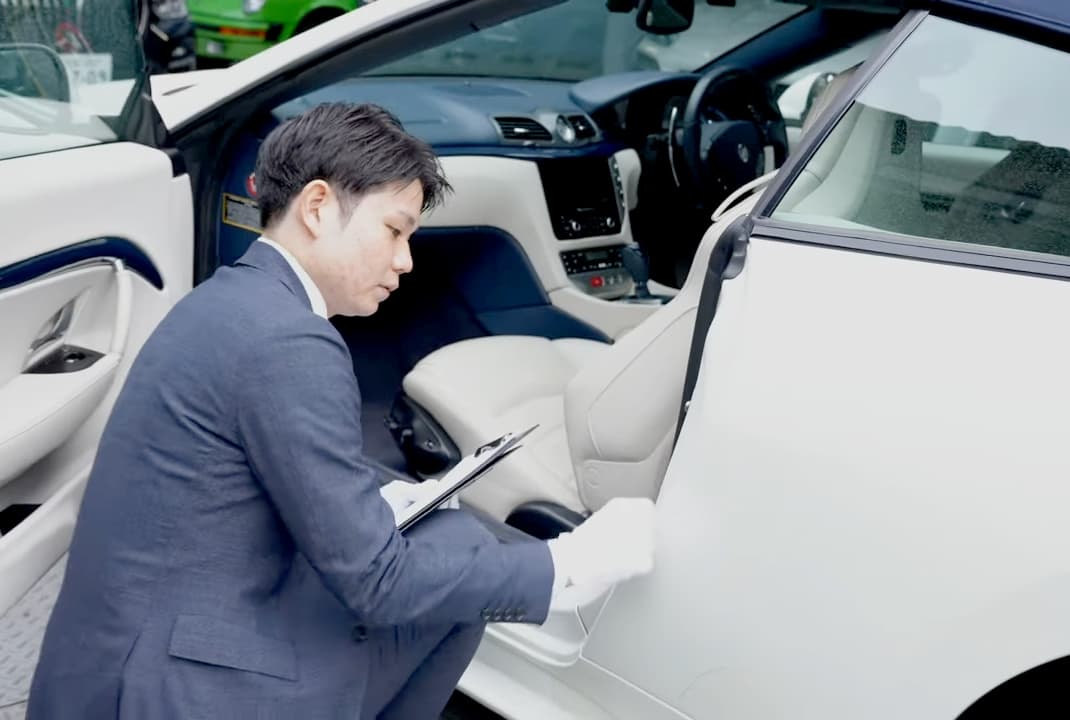
- Before the sale. Sellers bring their cars to the venue: new car dealers, used car dealers, companies that buy cars from private owners. An inspector of the auction house examines each car and fills in one sheet per car: grades, mileage, equipment, and a diagram of the marks on the body.
- The preview. Members see the list of cars with photos and sheets. Those at the venue can walk around the cars parked outside before the sale. Nobody takes them for a drive.
- The bidding. In most venues, the cars are no longer driven across a stage. Their photos appear on a screen, and members bid by pressing a button that raises the price. Several lanes run at the same time. The Osaka report counts about 20 seconds per car.
- Bidding from a distance. Venues are linked to each other, and members can take part in other venues' sales over the internet.
- The seller's price. The seller sets the price he hopes for. If the bidding does not reach it, the car is not sold and can come back another week. In 2015, a little over 60% of the cars offered found a buyer, nationally.
- After the sale. The buyer pays the auction house, usually within a few days, and the money passes through it to the seller. The buyer then collects the car. The auction house charges both sides: listing and success fees to the seller, a purchase fee to the buyer.
The scale
Most venues hold one sale a week, on a fixed day. According to the Osaka report, a small venue offers a few hundred cars per sale, a large one several thousand, and the largest more than 10,000. Nationwide, listings peaked at about 8.5 million a year.
The survey published by the Ministry of the Environment counted close to 8 million listings and about 4.1 million cars sold in 2005. A car that does not sell is listed again, so there are more listings than different cars. We found no recent national total from a public source: these figures show the scale, not today's market.
Each car receives an overall grade, and separate grades for the interior and the exterior. Each auction house has its own scale. We explain the grades in a separate article.
Read: Japanese auction grades explained
How it differs from auctions in Europe
A European buyer usually knows three kinds of car auctions. None works quite like a Japanese trade auction.
- Public collector-car auctions. An auction house publishes a catalogue, with a description and photos of each lot, often with its history file. There are viewing days before the sale. An auctioneer leads the bidding in the room, with bids by phone and online as well. Anyone can register. The buyer pays a premium on top of the hammer price.
- Online consumer auction platforms. A seller lists one car, with photos, often a video, and a description. Bidding stays open for several days, and anyone can ask questions in public comments. Private buyers and dealers can both bid.
- Trade remarketing auctions. Cars coming back from leasing, company fleets or trade-ins are sold to professionals, in a hall or online, with a condition report. The principle is the closest to the Japanese one: professionals only, a report written by someone other than the buyer, short bidding.
| Japanese trade auction | European collector-car auction | Online consumer platform | European trade remarketing auction | |
|---|---|---|---|---|
| Who can bid | Licensed dealers who are members | Anyone who registers | Anyone who registers | Professionals only |
| Cars per sale | Hundreds to thousands; over 10,000 at the largest venues | A selected catalogue | One car per listing | Depends on the sale |
| Condition information | One sheet per car, written by the auction house's inspector | Catalogue description, often a history file | Seller's description, photos, public questions | Condition report |
| Seeing the car | At the venue before the sale; no test drive | Viewing days | By arrangement with the seller, when possible | Depends on the sale |
| Bidding | A button, a screen, seconds per car | An auctioneer, lot after lot | Online, over several days | Live or timed online |
| Language of the documents | Japanese | Local language, often English too | Local language | Local language |
What it means for a private buyer in Europe
You cannot bid at a Japanese trade auction yourself: you would need a Japanese dealer's licence and a membership. You go through a company that has them.
With us, that company is TOPRANK Japan, the buying company of the TOPRANK group. It bids and buys in its own name, then exports the car. TOPRANK Europe, in Colmar, is your contact: it presents the cars, translates and manages your file. Here is what happens for an auction car:
- We search the auctions for the car you want. We also look at dealers, private owners and the group's own stock.
- We translate the sheet and explain each car: the grades, the marks on the diagram, what the inspector wrote.
- Depending on your pack, a physical inspection before purchase can be arranged.
- You approve a car and a maximum amount in your auction account. Nothing is bought without that approval.
- TOPRANK Japan bids up to your maximum. If the car sells higher, it goes to another buyer, and the search goes on.
- If the car is bought, TOPRANK Japan invoices it to you in yen (CIF, for an auction car) and organises the export.
The hammer price is only one line of the budget. Fees in Japan, sea transport, customs duties and import VAT come on top, and homologation if you want it.
Questions
Can I visit a Japanese trade auction?
Not as a bidder. Access is for members, and most venues check identity at the entrance. Whether a member may bring a guest depends on the venue's rules.
Are all Japanese used cars sold at auction?
No. Many are sold directly by dealers or bought from their owners. Auctions are one of our four sources in Japan.
Can I trust the sheet?
It is written by an inspector of the auction house, not by the seller. Since 2001, an industry association has worked on common guidelines for grades and for judging repair history. It remains a short, mostly visual inspection: it does not replace a mechanical check.
Sources
The facts in this article come from the sources below.
Keep reading

Your plans
A question about your car?
Tell us what you are looking for. We answer in French, English or German.