Model · JDM models
Honda Integra Type R: DC2 or DC5?
Two generations, two engines, one name. What separates the DC2 and the DC5 Integra Type R, what Europe got, and what to check before importing one from Japan.
Published on · 7 min read · TOPRANK Europe
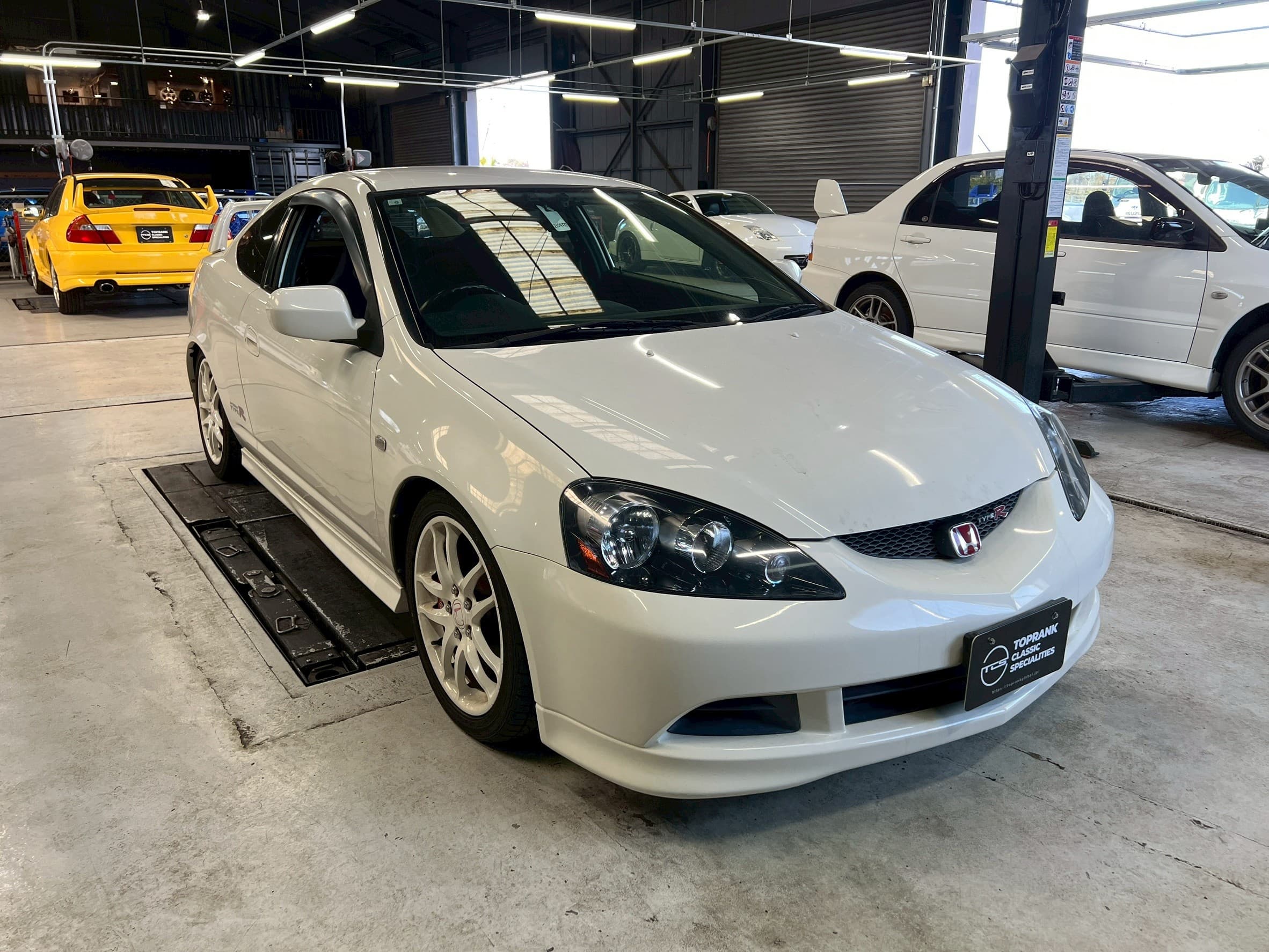
Honda sold the Integra Type R in Japan in two generations. The first, chassis code DC2, arrived in 1995 with a 1.8-litre engine. The second, the DC5, came in 2001 with a 2.0-litre engine and a new chassis. Both carry the same idea, but they are not the same car. Here is what separates them, using Honda's own figures.
The DC2: the first Integra Type R (1995)
Honda announced the Integra Type R on 24 August 1995. It went on sale in Japan on 16 October 1995. Honda says it applied the method of the NSX Type R to a small, light car. There was a three-door coupé, the DC2, and a four-door hardtop, the DB8.
Its engine is a B18C made for the Type R: 1,797 cc, 200 PS at 8,000 rpm and 18.5 kgm of torque at 7,500 rpm. Honda presented it as a naturally aspirated engine with 111 PS per litre. The gearbox is a five-speed manual, and only that.
- Chassis: double wishbones front and rear, firmer springs and damper mountings than the standard Integra, extra bracing for the body.
- Traction: a torque-sensing helical limited-slip differential.
- Steering: a quick 15.7:1 ratio.
- Cabin: Recaro bucket seats, a 350 mm MOMO steering wheel, a titanium gear knob.
- Weight: 1,060 kg for the three-door coupé, according to Honda's specification sheet.
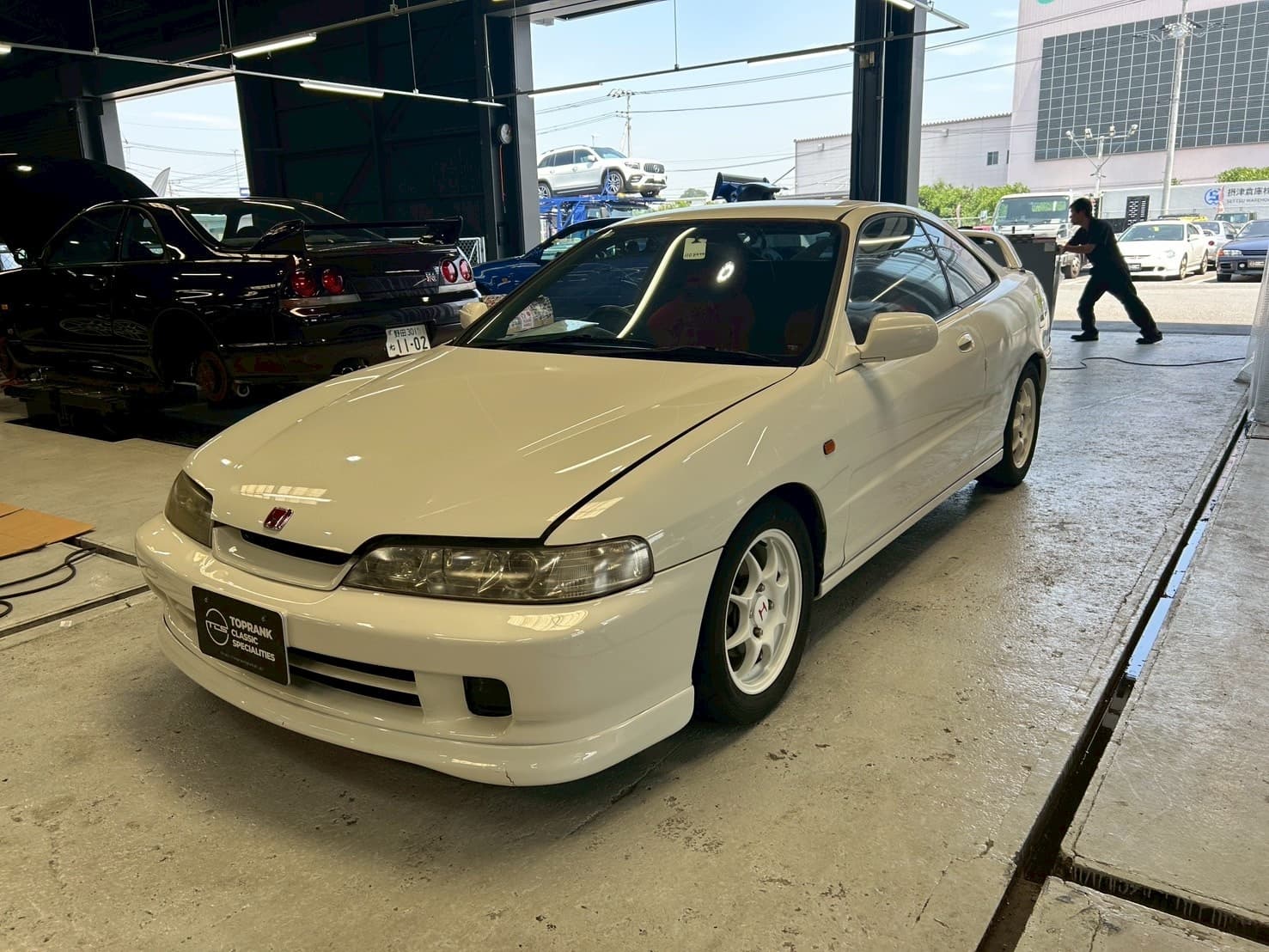
98 spec and Type R·X
In January 1998, Honda revised the Type R. The new engine, called B18C 98spec.R, has an equal-length stainless exhaust manifold for more mid-range torque. The brakes grew to 15-inch discs at the front and 14-inch at the rear. Tyres went from 195/55 R15 to 215/45 ZR16 on new five-stud wheels.
In December 1999, Honda added a Type R·X with more equipment: CD audio, keyless entry, manual air conditioning and a few trim parts. These items came on top of the standard Type R, which did not have them.
The DC5: the second Integra Type R (2001)
The new Integra went on sale in Japan on 2 July 2001. This time Honda developed the Type R at the same time as the standard car, not afterwards. Honda says the stiffer body designed for the Type R was also used on the standard model.
The engine is a K20A: 1,998 cc, 220 PS at 8,000 rpm, 206 Nm at 7,000 rpm, with a compression ratio of 11.5. Honda says it is about 10 kg lighter than the B18C. It comes with a new close-ratio six-speed manual gearbox and a chromoly flywheel with about 30% less inertia.
- Brakes: front brakes developed with Brembo.
- Chassis: MacPherson struts at the front, double wishbones at the rear.
- Tyres: 215/45 ZR17.
- Weight: 1,170 kg without air conditioning, 1,180 kg with it.
In September 2004, Honda updated the DC5: new headlights, grille and bumpers, large white gauges, a stiffer body around the suspension mountings and revised suspension. Power stayed at 220 PS. The Integra left Honda's range in September 2006.
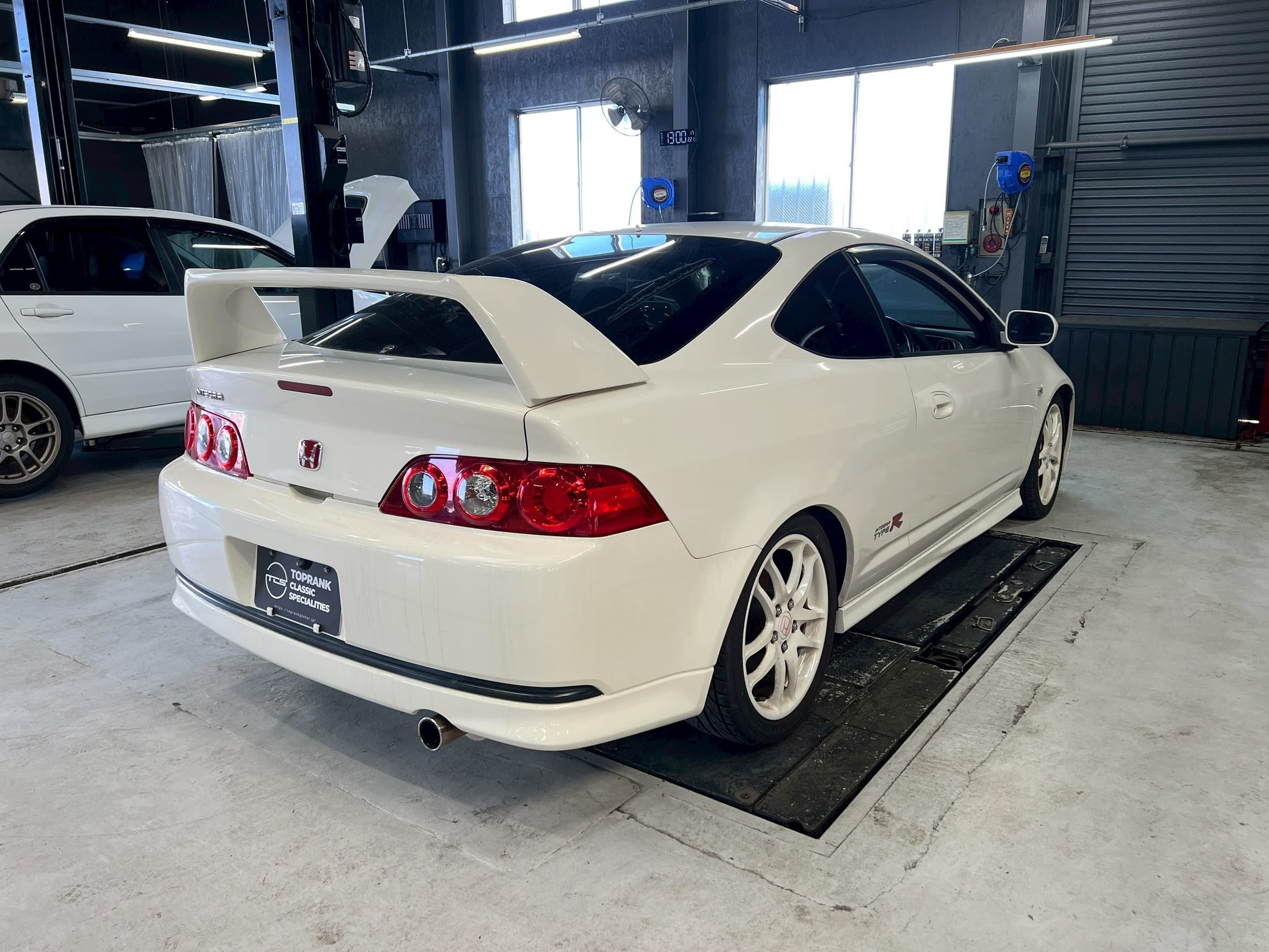
Side by side
| DC2 (1995) | DC5 (2001) | |
|---|---|---|
| Engine | B18C, 1,797 cc | K20A, 1,998 cc |
| Power | 200 PS at 8,000 rpm | 220 PS at 8,000 rpm |
| Torque | 18.5 kgm at 7,500 rpm | 206 Nm at 7,000 rpm |
| Camshaft drive | Belt | Chain |
| Gearbox | 5-speed manual | 6-speed manual |
| Front suspension | Double wishbone | MacPherson strut |
| Tyres | 195/55 R15 (215/45 ZR16 from 1998) | 215/45 ZR17 |
| Weight | 1,060 kg | 1,170 kg (without air conditioning) |
Japanese versions and European versions
The DC2 Type R was sold officially in the United Kingdom, from 1998 to 2001, according to PistonHeads. That press source gives about 190 PS for the British car, front discs of 282 mm against 262 mm on early Japanese cars, and a rear fog light built into the bumper. Early Japanese cars have one-piece headlights. We did not find a reliable source for the other European countries.
The DC5 Type R was never sold officially in the United Kingdom, as PistonHeads notes. Those found in Europe today came from Japan as private imports. In practice, a DC5 Type R in Europe is a Japanese-market car.
What to check before buying one
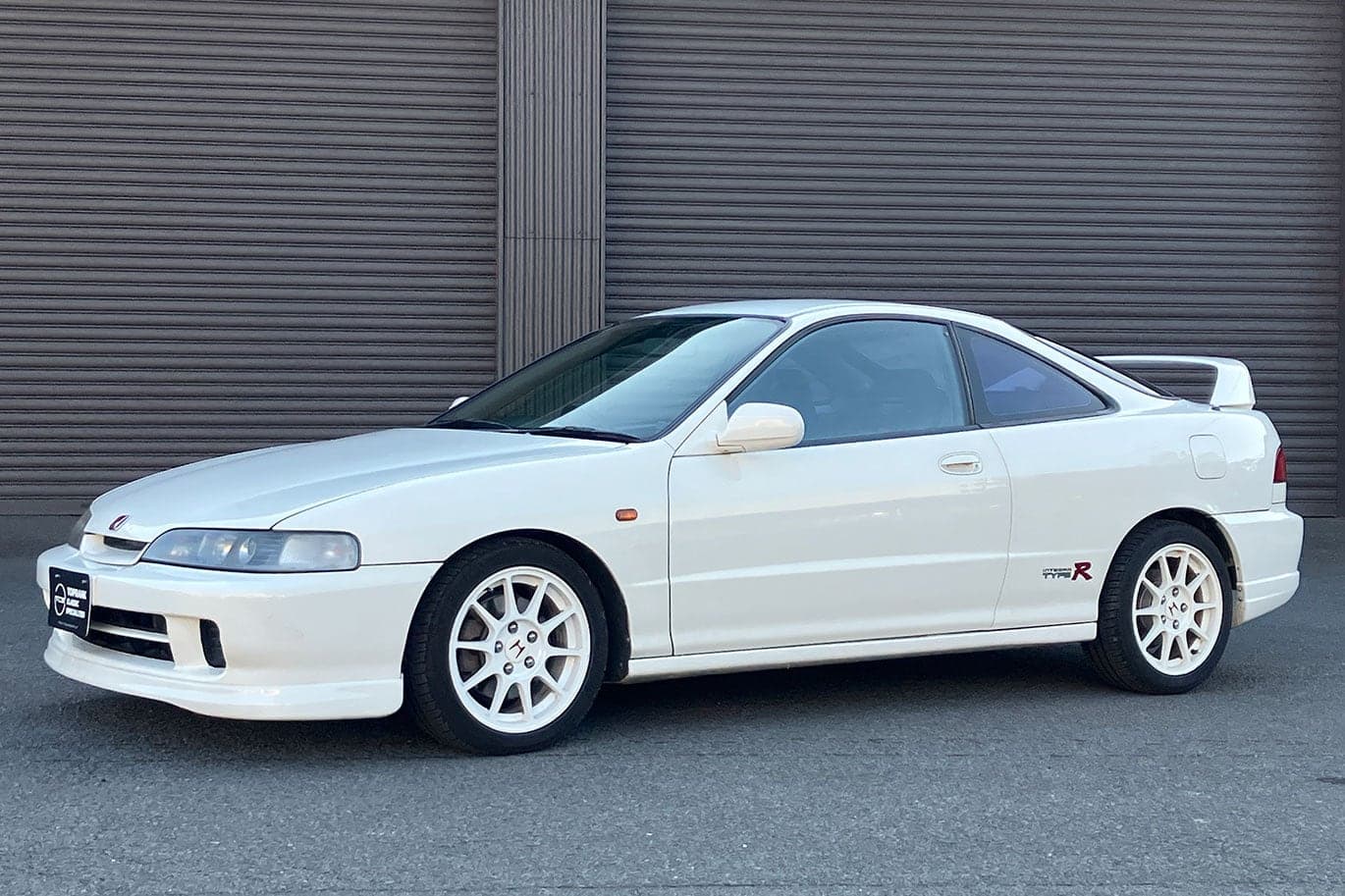
The youngest DC2 is about 25 years old, the youngest DC5 about 20. Many of these cars have been driven hard. The two TOPRANK cars on this page both had aftermarket parts: suspension, exhaust, brakes.
- Rust: the rear wheel arches, a known weak point on the DC2.
- Accidents and track use: panel gaps, repaint, signs of a car that has been on track or off the road.
- Oil: the B18C uses some oil even when driven gently. Check the level and ask how often it was changed.
- Timing belt: the B18C has one. PistonHeads gives 60,000 miles (about 96,000 km) or five years. The K20A has a chain.
- Gearbox: on the DC2, second and third gear synchros can wear with track use. Check the clutch too.
- Suspension: worn bushes and tired dampers change the way the car drives.
- Seats: the Recaro seats wear, especially on the driver's side.
- Modifications: list what is not original. It matters for homologation.
The documents matter as much as the car.
Read: the history of a Japanese car
Importing one into Europe
TOPRANK Japan buys the car in Japan in its own name and exports it. TOPRANK Europe supports you and handles homologation in France and Germany from Colmar.
The age of the car decides the route. The first DC2s date from 1995. Once a car is 30 years old, in France it can apply for collector status if it is in original condition. A younger DC2 and every DC5 go through an individual approval: RTI with the DREAL in France, TÜV §21 in Germany.
Questions and answers
Which one is more powerful?
The DC5: 220 PS against 200 PS for the DC2, according to Honda. The DC5 is also about 110 kg heavier, comparing Honda's figures for each base car.
Was the DC5 Type R sold in Europe?
Not officially in the United Kingdom, according to PistonHeads. We found no reliable source showing an official sale elsewhere in Europe.
Was there a four-door Integra Type R?
Yes, in Japan, at the 1995 launch: the four-door hardtop, chassis code DB8, with the same B18C engine.
Can you find one for me in Japan?
Yes. Tell us the generation, the condition you want and your budget. TOPRANK Japan searches, checks the car and buys it.
Sources
The facts in this article come from the sources below.
- Honda Japan — Integra Type R, model history (Japanese)
- Honda — press release, Integra Type R launch, 24 August 1995 (Japanese)
- Honda — fact book, Integra 1995.08, specifications (Japanese)
- Honda — press release, Integra minor change and Type R 98 spec, 29 January 1998 (Japanese)
- Honda — press release, Civic and Integra Type R·X, 16 December 1999 (Japanese)
- Honda — press release, new Integra and Type R, 2 July 2001 (Japanese)
- Honda — fact book, Integra 2001.07, specifications (Japanese)
- Honda — Integra catalogue 2004–2006, specifications (Japanese)
- PistonHeads — Honda Integra Type R (DC2) buying guide
- PistonHeads — Honda Integra Type R (DC5) spotted
- TOPRANK Global — 2005 Honda Integra Type R (DC5), stock 116189
- TOPRANK Global — 1996 Honda Integra Type R (DC2), stock 110502
Keep reading
Your plans
A question about your car?
Tell us what you are looking for. We answer in French, English or German.