Model · European models
Ferrari F430: manual or F1 gearbox, and what to check
A new 4.3-litre V8, the electronic differential, the manettino on the steering wheel, and the choice between a gated manual and the F1 paddles. The F430, its versions, and the points to check before buying.
Published on · 7 min read · TOPRANK Europe
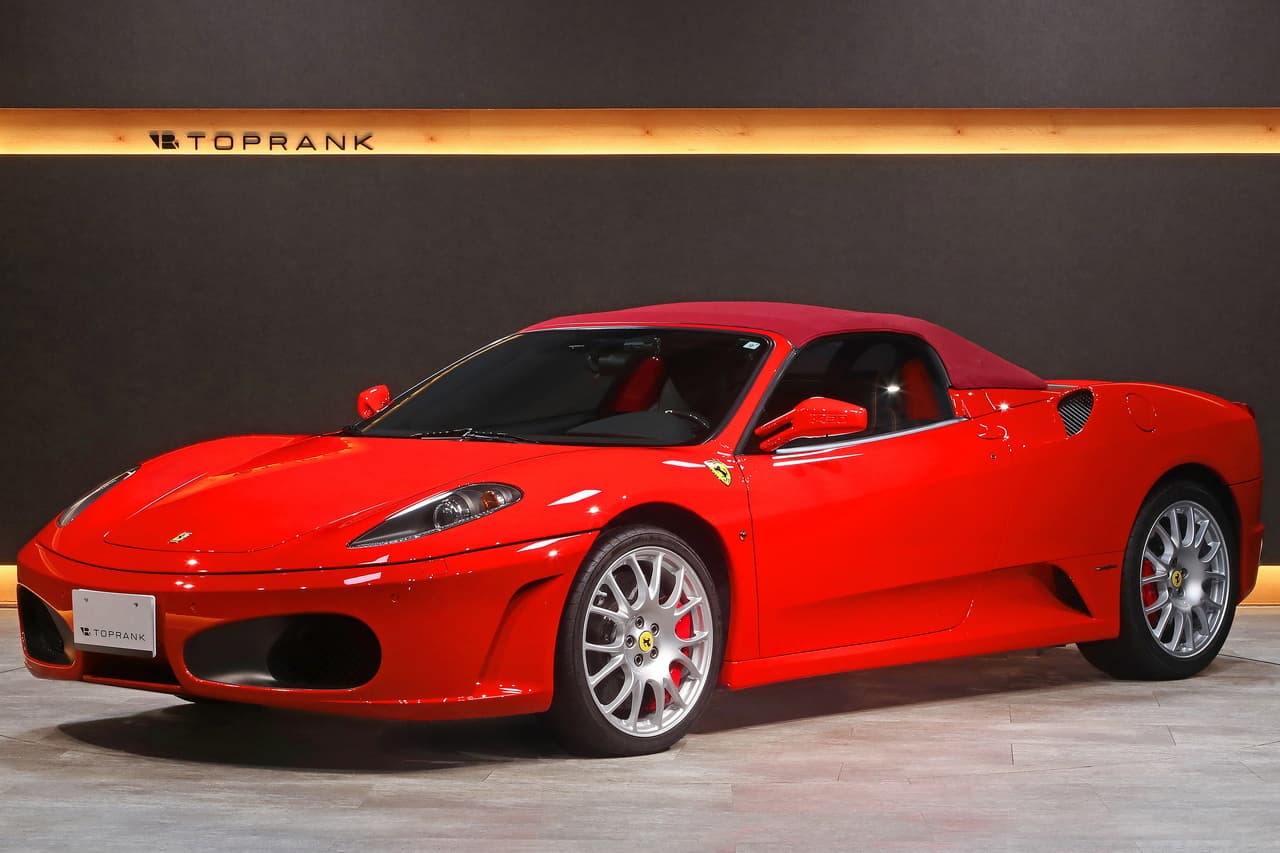
Ferrari presented the F430 in 2004 to replace the 360 Modena. Ferrari says that little was carried over from the 360, and that the car drew on the work of its Formula 1 department. In 2009 the 458 Italia took its place. In between came a Spider, a lighter 430 Scuderia, and a limited-series Scuderia Spider 16M.
A new V8
The engine shares no component with the 360 Modena's. It is a 90° V8 with a flat-plane crankshaft, as on every mid-engined Ferrari V8. Displacement grows from 3,586 cc to 4,308 cc, yet Ferrari says the engine gained only 4 kg.
| F430 (2004) | |
|---|---|
| Engine | 90° V8, flat-plane crank, 4,308 cc, mid-mounted |
| Power | 490 CV (360 kW) at 8,500 rpm |
| Torque | 465 Nm at 5,250 rpm, 80% of it from 3,500 rpm |
| Camshaft drive | Chains (no timing belt) |
| Gearbox | Six-speed manual or F1 |
| Weight | 1,350 kg dry, 1,450 kg kerb weight (European version) |
| Weight distribution | 43% front, 57% rear |
| Performance | 0–100 km/h in 4.0 s, over 196 mph (about 315 km/h) |
E-Diff and manettino
- E-Diff. An electronically controlled differential, standard on the F430. Ferrari states it was the first time a production car was fitted with such a system. Its job is to put the power down out of corners without wheelspin.
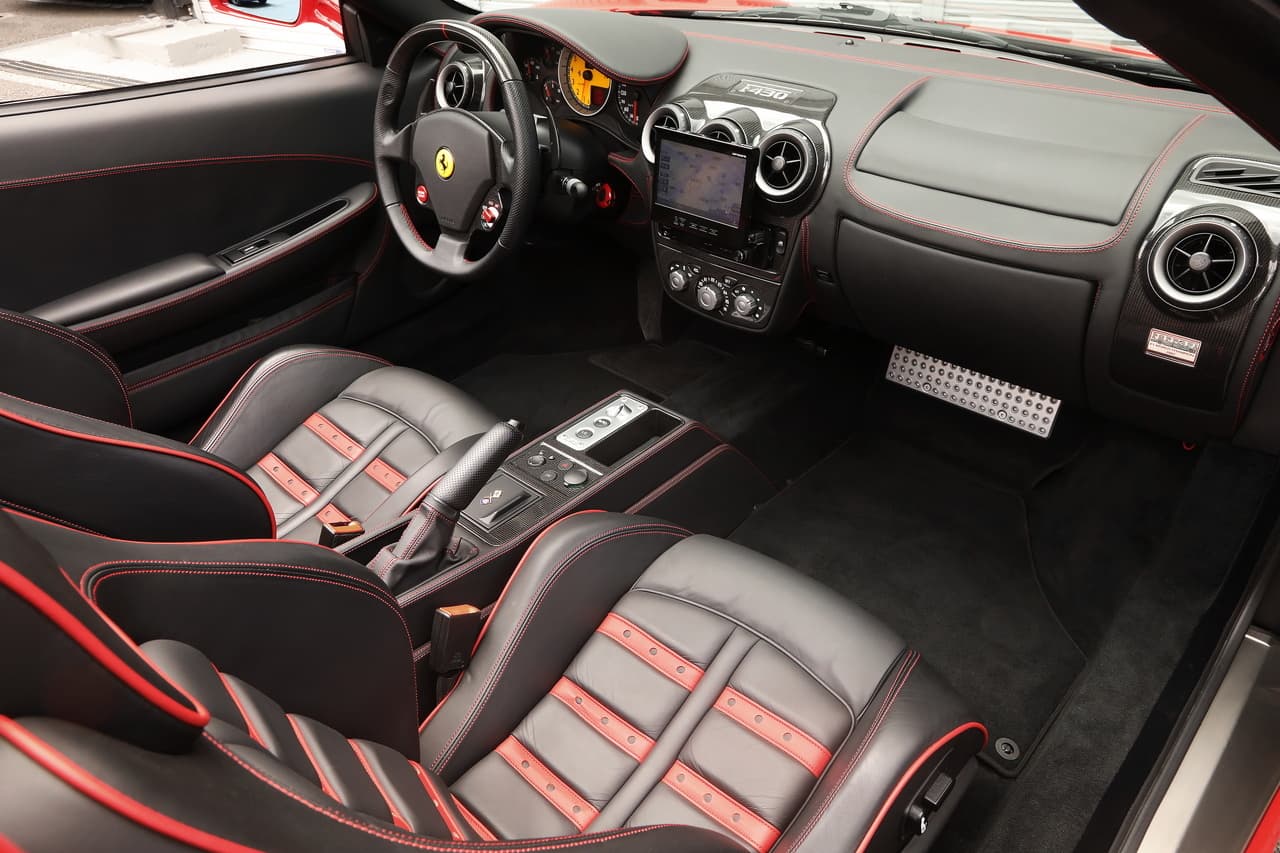
- Manettino. A rotary switch on the steering wheel that changes the car's set-up: traction control, stability control, gearshift and suspension settings. Ferrari presents it as taken directly from its Formula 1 cars. The starter button is on the wheel too.
Manual or F1?
The F430 was offered with two gearboxes. The manual has a lever in an open metal gate. The F1 is the same six-speed gearbox, shifted by an electro-hydraulic system and paddles behind the wheel. Ferrari's own figures show almost no difference in pace:
| Manual | F1 | |
|---|---|---|
| 0–400 m | 12.00 s | 11.95 s |
| 0–1,000 m | 21.65 s | 21.60 s |
Most buyers chose the F1. Manual cars are a minority; we found no official figure for their share. The 430 Scuderia and the Scuderia Spider 16M were offered with the F1 gearbox only. According to the specialist press, the F430 was the last mid-engined Ferrari V8 offered with a manual: the 458 Italia that followed had none.
The choice is above all one of taste. The F1 needs regular fluid changes and has its own wear points (see below). The manual needs nothing special, but you will see fewer of them.
Spider, Scuderia and 16M
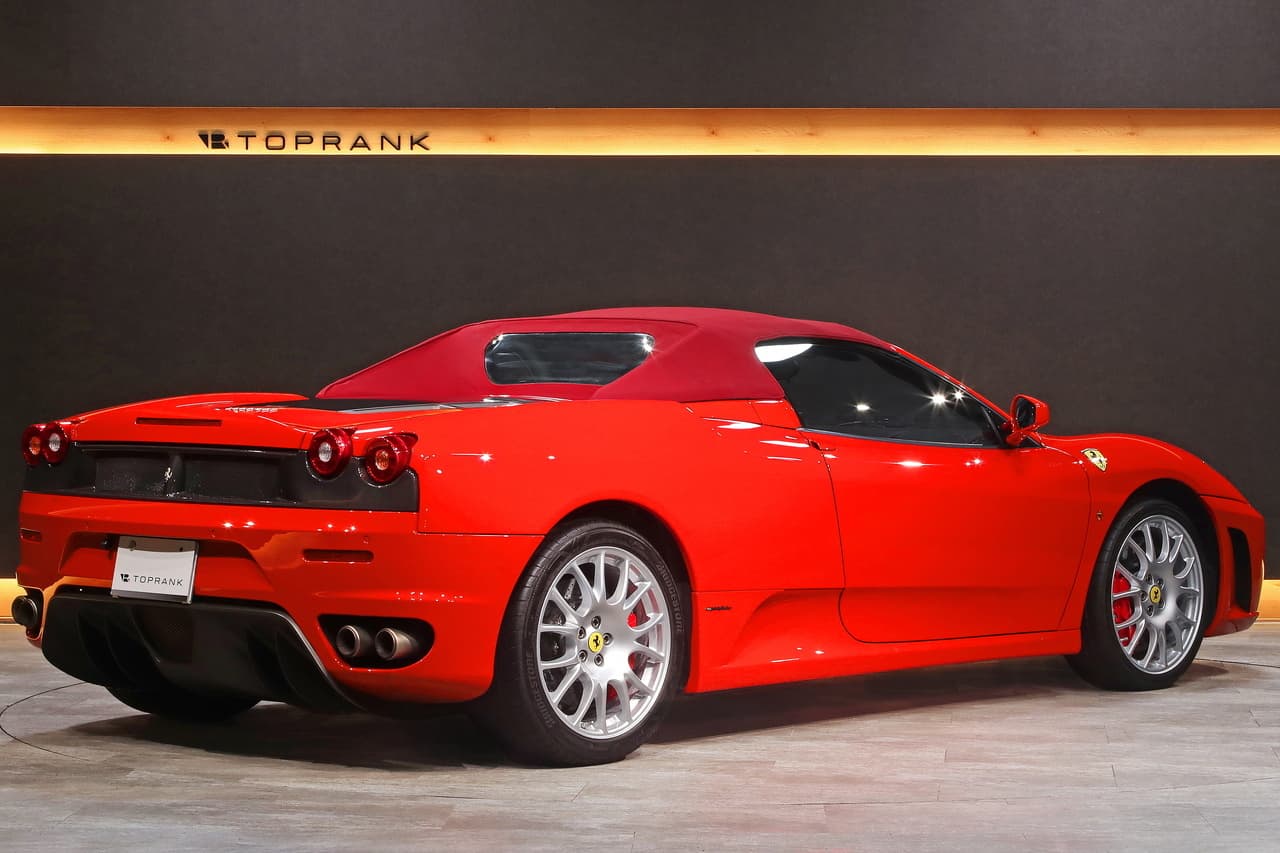
- F430 Spider (2005): same engine, a fully automatic electric soft top that leaves the engine visible. 1,420 kg dry, 0–100 km/h in 4.1 s.
- 430 Scuderia (2007): 510 CV and 470 Nm, 1,250 kg dry, 15 mm lower, F1 gearbox only (F1-SuperFast2), E-Diff combined with F1-Trac traction control, carbon-ceramic brakes. Michael Schumacher took part in its development.
- Scuderia Spider 16M (2008): named after Ferrari's 16th constructors' title in Formula 1. A limited series of 499 cars, 510 CV, 1,340 kg dry.
What to check before buying
The British specialist press (evo, PistonHeads) agrees that the core of the engine is strong if the yearly service has been done. It names the following points.
- Exhaust manifolds: they crack on many cars, more often on early ones. Ferrari often fitted a revised part under warranty. The risk: debris from a failing catalyst drawn into the engine. Listen for a ticking or blowing sound.
- F1 gearbox: fluid change every three years; air in the system can cause selection problems; check the actuator for leaks.
- Clutch: estimates of its life vary widely, from about 12,000 to 30,000 miles depending on use. Ask when it was last changed.
- E-Diff: a faulty solenoid can disable it. Check that no warning is shown.
- Suspension: ball joints are the main weak point. Clonks over bumps, or steering that does not self-centre, point to worn joints.
- Timing chains: evo advises checking them at about 43,000 miles (70,000 km).
- Details: rear lights that rattle, hazy headlights, misting inside the instrument cluster.
An F430 from Japan
The TOPRANK group sells Ferraris in Japan from its own showrooms; the photos in this article show a 2009 F430 Spider F1 from its stock. TOPRANK Japan buys the car in its own name, then exports it. We tell you which side the steering wheel is on for every car we offer: many Ferraris in Japan have it on the left, not all.
A car built for the Japanese market is not registered automatically in Europe. In France, the usual route is the individual approval (RTI); the manufacturer's document is not included in our price, you order it from Ferrari. In Germany, the car goes through a TÜV individual approval, done at our Colmar site. A rear fog light on the left and headlights approved for Europe are mandatory.
Questions
Is a manual F430 better?
Not faster, according to Ferrari's own figures. It is simpler and rarer. The F1 shifts by itself and suits more drivers. Choose the one you want to drive.
Does the F430 have a timing belt?
No. Ferrari changed to chains on this engine. Their condition is checked at service.
Can you look for a 430 Scuderia or a 16M?
Yes. Tell us which one: we search the group's stock and the Japanese market.
Sources
The facts in this article come from the sources below.
- Ferrari — F430 (2004), model page
- Ferrari — F430 Spider (2005), model page
- Ferrari — 430 Scuderia (2007), model page
- Ferrari — Scuderia Spider 16M (2008), model page
- Ferrari — 458 Italia (2009), model page
- evo — Ferrari F430 used buying guide (24 January 2020)
- PistonHeads — Ferrari F430 buying guide: powertrain (6 July 2017)
- TOPRANK (Japan) — stock: 2009 Ferrari F430 Spider F1
Keep reading
Your plans
A question about your car?
Tell us what you are looking for. We answer in French, English or German.