Model · European models
Ferrari F12berlinetta: the front-engined V12, and buying one in Japan
A 6.3-litre V12 of 740 CV, mounted at the front, with the gearbox at the rear. What Ferrari built in 2012, the F12tdf that followed, and what to check before buying one in Japan.
Published on · 7 min read · TOPRANK Europe
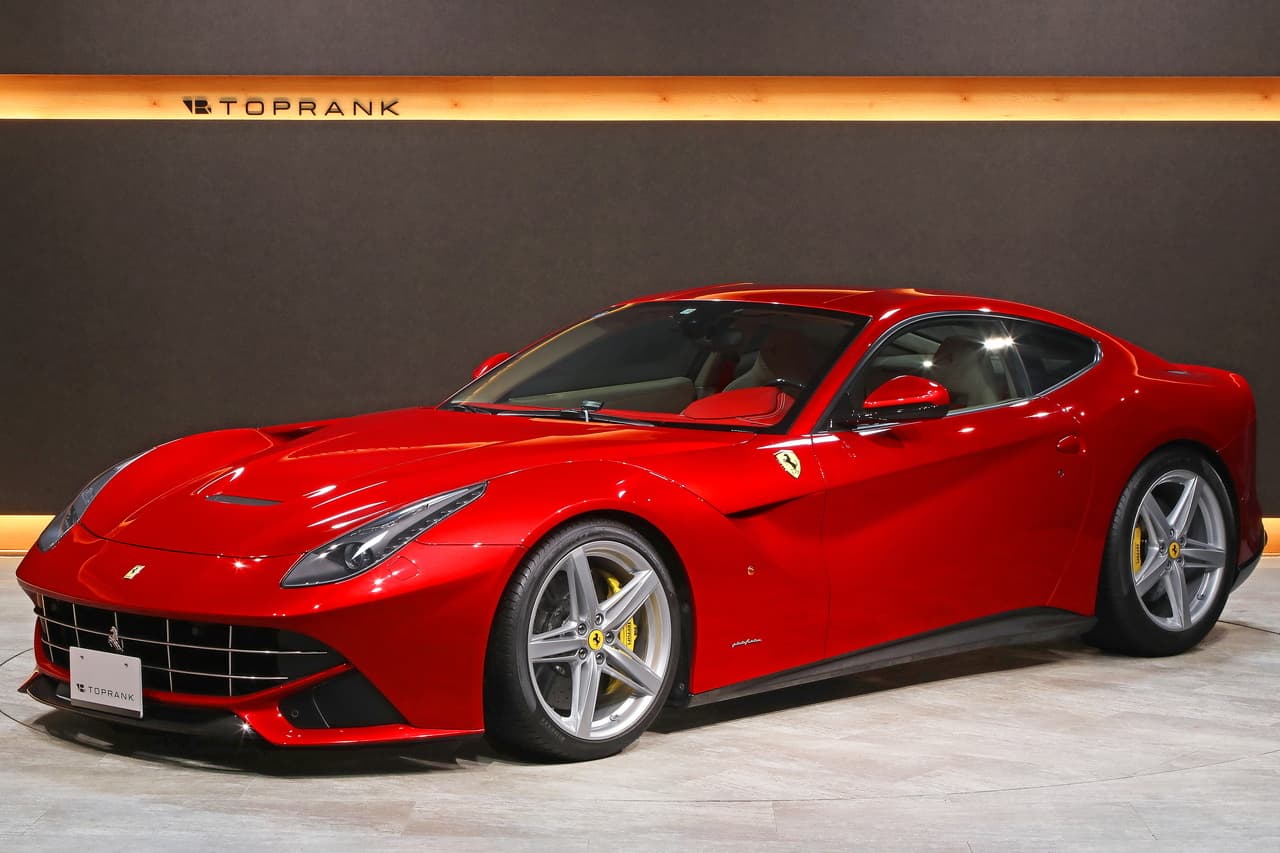
In 2012, Ferrari replaced the 599 GTB Fiorano with the F12berlinetta. It keeps the classic layout of Ferrari's grand tourers: a V12 at the front, the driven wheels at the rear, two seats. On its own page, Ferrari calls it the highest-performing car in its history.
The V12, in Ferrari's figures
| F12berlinetta (2012) | |
|---|---|
| Engine | 65° V12, 6,262 cc, naturally aspirated, direct injection at 200 bar |
| Power | 740 CV (545 kW) at 8,250 rpm |
| Torque | 690 Nm at 6,000 rpm, 80% of it available from 2,500 rpm |
| Rev limit | 8,700 rpm |
| Gearbox | F1 dual-clutch, at the rear, with the electronic differential |
| Weight | 1,525 kg dry (with lightweight options), 1,630 kg kerb weight |
| Weight distribution | 46% front, 54% rear |
| Performance | 0–100 km/h in 3.1 s, 0–200 km/h in 8.5 s, over 340 km/h |
Ferrari placed the engine 30 mm lower and further back in the chassis than in the 599 GTB Fiorano. The gearbox sits at the rear axle. The result is a front-engined car with more weight at the rear than at the front.
What makes it different
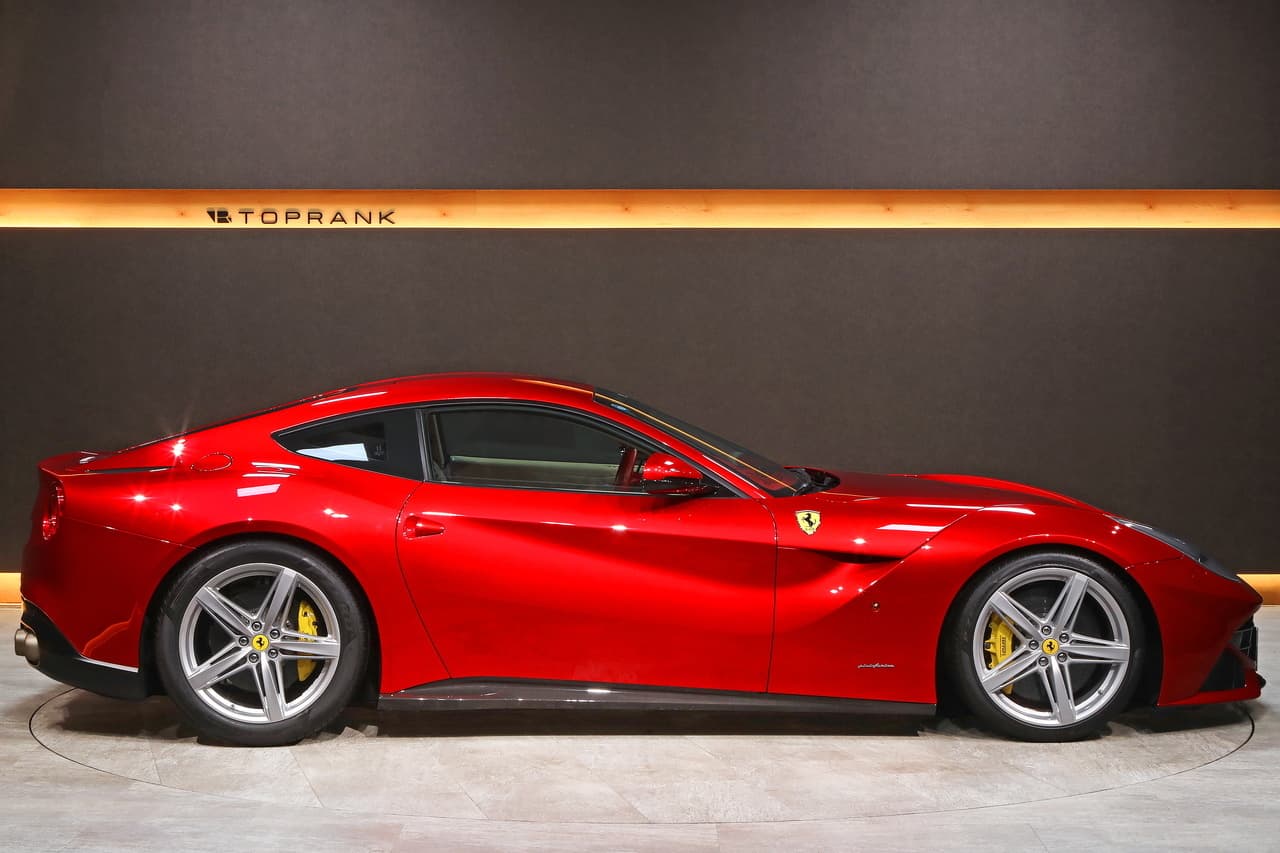
- The Aero Bridge. A channel runs from the bonnet, under a bridge, along the flank. Ferrari says it was the first time the bonnet was used to create downforce. Downforce is 123 kg at 200 km/h, with a drag coefficient of 0.299.
- Active brake cooling. Flaps in the brake ducts open only when the brakes are hot, and stay closed the rest of the time to reduce drag.
- Chassis electronics. Third-generation E-Diff, F1-Trac traction control, magnetorheological dampers (SCM-E), carbon-ceramic brakes (CCM3).
- A real grand tourer. A tailgate instead of a boot lid: 320 litres of luggage, up to 500 litres with the rear shelf.
Inside
Ferrari grouped the main controls on the steering wheel and the key information in the centre of the instrument panel, in front of the driver. The F1 paddles stay with the wheel. The manettino sets the electronic systems; in its sportiest positions, a display tells the driver whether the brakes, engine and tyres are cold, ready or too hot.
The interior is trimmed in Frau leather. An extra display for the passenger was an option. Ferrari also quotes fuel consumption 30% lower than that of the 599 GTB Fiorano, despite more power and torque.
The F12tdf
In 2015, Ferrari added the F12tdf, named after the Tour de France automobile, an endurance event Ferrari dominated in the 1950s and 1960s. It is a sharper version of the same car, built in a limited series: the specialist press gives 799 cars, between 2015 and 2017.
| F12berlinetta | F12tdf | |
|---|---|---|
| Power | 740 CV at 8,250 rpm | 780 CV at 8,500 rpm |
| Torque | 690 Nm | 705 Nm |
| Rev limit | 8,700 rpm | 8,900 rpm |
| Dry weight | 1,525 kg | 1,415 kg |
| Downforce at 200 km/h | 123 kg | 230 kg |
| 0–100 km/h | 3.1 s | 2.9 s |
Ferrari also gave the F12tdf gear ratios 6% shorter, wider front tyres, and a steering rear axle, presented for the first time on this car.
What to check before buying
The F12berlinetta has no widely reported mechanical weak point. PistonHeads, in its buying guide, lists mostly minor faults and things to watch.
- History: complete Ferrari service records, and what was done under Ferrari's maintenance programme.
- Fuel: owners are advised not to run the tank very low; the fuel system does not like an irregular supply.
- Electrics: reported glitches include a climate control that does not restart, warnings for the parking brake or ABS, and a window that does not seat fully. Restarting or locking and unlocking often clears them.
- Body: corrosion has been found under the paint around the rear wing vents on some cars. Check this area closely.
- Fuel filler flap: some have been reported opening while driving.
- Brakes: carbon-ceramic discs are standard. Have their wear measured; they are expensive to replace.
- Options: check what the car has, for example the front lift system, which matters on ramps and speed bumps.
Buying an F12 in Japan
The TOPRANK group sells Ferraris in Japan from its own showrooms. On 15 November 2026, its stock listed four F12berlinettas, from 2013 to 2015. We start there, then widen the search to the rest of the Japanese market. TOPRANK Japan buys the car in its own name, then exports it.
- Steering wheel. Many Ferraris in Japan have left-hand drive, but not all. We tell you which side it is on for every car.
- Registration. A car built for the Japanese market is not registered automatically in Europe. In France, the usual route is the individual approval (RTI); the manufacturer's document is not included in our price, you order it from Ferrari. In Germany, a TÜV individual approval, done at our Colmar site.
- Mandatory modifications. A rear fog light on the left and headlights approved for Europe. Allow for these costs on top.
- Customs. In practice, plan for 10% customs duty and import VAT. The calculator adds it all up.
Questions
How many F12berlinettas were built?
Ferrari did not publish a total. PistonHeads estimates about 4,600. For the F12tdf, the figure given is 799.
What replaced it?
The 812 Superfast, in 2017.
Why are there left-hand-drive Ferraris in Japan?
For decades, European sports cars were sold in Japan as they were built for their home market. Our article explains the history.
Sources
The facts in this article come from the sources below.
Keep reading
Your plans
A question about your car?
Tell us what you are looking for. We answer in French, English or German.