Model · European models
Ferrari F40: what it is, and why some are in Japan
A twin-turbo V8, a body made mainly of composites, and 1,311 cars according to Ferrari. What the F40 is, why Japan is part of its story, and what buying one there involves.
Published on · 6 min read · TOPRANK Europe
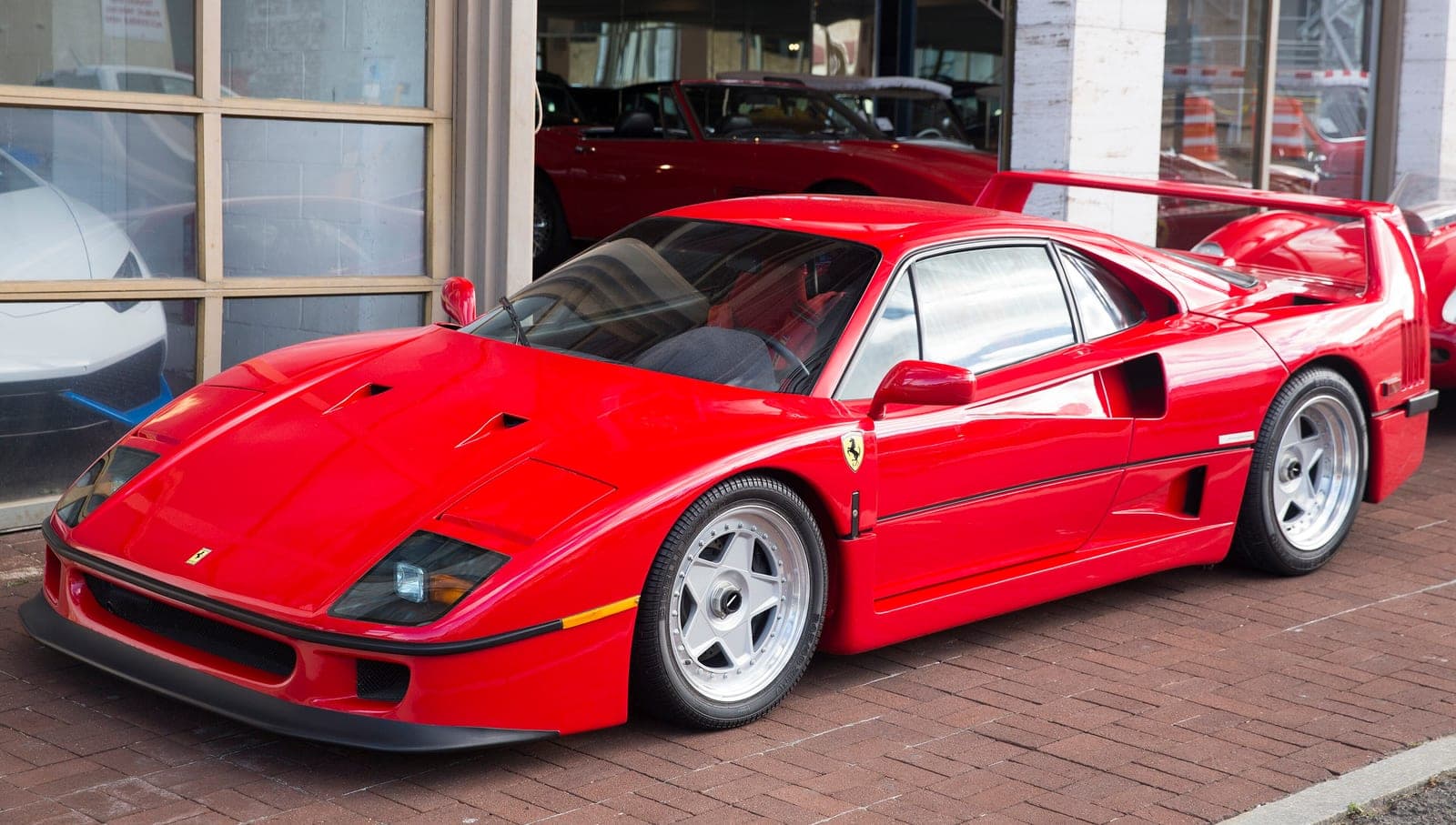
The Ferrari F40 was presented in the summer of 1987, for the 40th anniversary of the first Ferrari approved for road use. It was also the last car unveiled in the presence of Enzo Ferrari, who died in August 1988. Some F40s are in Japan today. Here is what the car is, in Ferrari's own figures, why Japan is part of its story, and what buying one there involves.
What it is
Ferrari calls the F40 its second supercar. The name is simple: F for Ferrari, 40 for the anniversary. The car was presented to the press on 21 July 1987. Ferrari describes it as a race car for road use: a two-seater berlinetta designed by Pininfarina, on a frame of tubular steel and composites.
Production ended in 1992. According to Ferrari, 1,311 cars left the Maranello factory. Other sources give figures of up to 1,315. We use Ferrari's figure.
The engine and the figures
Behind the seats sits a 90° V8 of 2,936 cc, mounted lengthwise, with two turbochargers, Weber-Marelli electronic injection and dry-sump lubrication. Ferrari quotes a specific output of almost 160 hp per litre. The gearbox is a five-speed manual, with a twin-plate clutch.
| Ferrari F40 | |
|---|---|
| Engine | 90° V8, twin turbo, 2,936 cc |
| Maximum power | 478 hp (351.5 kW) at 7,000 rpm |
| Maximum torque | 577 Nm at 4,000 rpm |
| Gearbox | 5-speed manual |
| Weight | 1,100 kg (dry) |
| Top speed | 324 km/h |
| 0 to 100 km/h | 4.1 seconds |
| Production | 1987 to 1992, 1,311 cars |
A body made of composites
The F40 was the first Ferrari production car to use mainly composite materials for its body panels. Ferrari counts only eleven panels, thanks to large one-piece front and rear sections. The rear section can be removed entirely, which gives access to all the mechanical parts.
Other details tell the same story of a race car for the road: split-rim Speedline wheels held by a single central nut, and large drilled and ventilated brake discs, without servo assistance.
Why some are in Japan
The F40 arrived at the height of Japan's “bubble economy”, the economic boom of the late 1980s. The Japanese press still treats it as a symbol of that period: in 2019, the site Kuruma News recalled its popular nickname, “running real estate”.
We have found no reliable figure for the number of F40s delivered new to Japan, or still there today, so we do not give one. With so few cars in the world, finding one is a search, not a choice from a list.
Ferrari Classiche certification
Ferrari Classiche is the Ferrari department that looks after historic models. Its Certificate of Authenticity is available for road cars over 20 years old, among others. It traces the history of the car and checks that it conforms to the original design, and where each component comes from. Ferrari describes four steps:
- Inspection, by Ferrari Classiche or by an authorised dealer: photographs, measurements and technical data.
- Technical analysis. First, the chassis must be original: Ferrari calls this an essential requirement. Then the body and interior are compared with the original specifications, and the mechanical and electrical systems are checked.
- Result. A report goes to a Certification Committee, which accepts or rejects it. If a problem cannot be waived, the process stops until the parts concerned are replaced.
- The certificate, signed by Piero Ferrari, with a document of photographic and technical evidence.
A car may or may not have this certificate. What matters is to know which, before buying, and why.
What to check on a car of this calibre
- Identity. The chassis number on the car must match the Japanese papers and the export documents.
- The history file. Invoices, previous owners, Japanese inspection records. A car's past in Japan can often be traced through its compulsory inspections.
- Classiche status. Certified, in progress, or never requested. If the car is certified, the certificate and its file must come with it.
- Body repairs. On a body made mainly of composite panels, any repair should be declared and documented.
- Originality. Which parts were changed over the years, and whether the original ones were kept.
- A specialist inspection before the purchase is final.
Importing an F40 from Japan
TOPRANK Japan, part of the TOPRANK Co., Ltd. group, buys the car in Japan in its own name and exports it. TOPRANK Europe supports you throughout and handles the homologation in France or Germany, from its site in Colmar.
Even with a Ferrari badge, a car sold in Japan was built to Japanese rules. It is not registered automatically in Europe. Every F40 is now more than 30 years old. In France, a car of 30 years or more, in its original condition, can apply for collector status with the FFVE certificate. In Germany, the car goes through a TÜV individual approval at our Colmar site, then German registration. We check the route for your car before you buy.
As a rule, customs duty and import VAT apply to a car imported from Japan, unless customs recognises it as a collector's item. The calculator adds it all up.
Why do so many European sports cars in Japan have the steering wheel on the left? We explain it in a separate article.
Read: left-hand-drive cars in Japan
Questions
Is every F40 more than 30 years old?
Yes. Ferrari ended production in 1992. In France, a car of 30 years or more, in its original condition, can apply for collector status with the FFVE certificate.
How many F40s were built?
Ferrari states 1,311 cars. Some other sources give up to 1,315.
Must an F40 have the Ferrari Classiche certificate?
No. It is a certification offered by Ferrari to owners. It tells you that Ferrari has checked the car against its original design. If a car does not have it, ask why.
Is an F40 cheaper in Japan?
We make no such claim. What Japan offers is choice, and a history that can be documented car by car.
Can you find one for me?
We can search, with TOPRANK in Japan. Tell us what you are looking for.
Sources
The facts in this article come from the sources below.
- Cover photo: “Ferrari F40 in Red, federal model, front left” by Mr.choppers, CC BY-SA 4.0 (creativecommons.org/licenses/by-sa/4.0), via Wikimedia Commons; resized, same licence
- Ferrari — Ferrari F40 (1987), history and technical details
- Ferrari — Ferrari Classiche
- Ferrari — Ferrari Classiche certification
- Wikipedia — Ferrari F40 (production figures quoted by other sources)
- Kuruma News — the F40 called “running real estate” (Japanese, 27 November 2019)
Keep reading
Your plans
A question about your car?
Tell us what you are looking for. We answer in French, English or German.