


Vehicle guide
Mitsubishi Lancer Evolution IV: history, AYC and buying guide
The Lancer Evolution IV brought a revised platform and Active Yaw Control to Mitsubishi’s rally-derived saloon. Before buying, distinguish RS from GSR, establish what equipment remains fitted and review the drivetrain’s maintenance. This guide connects the model’s history with the checks an individual car needs.
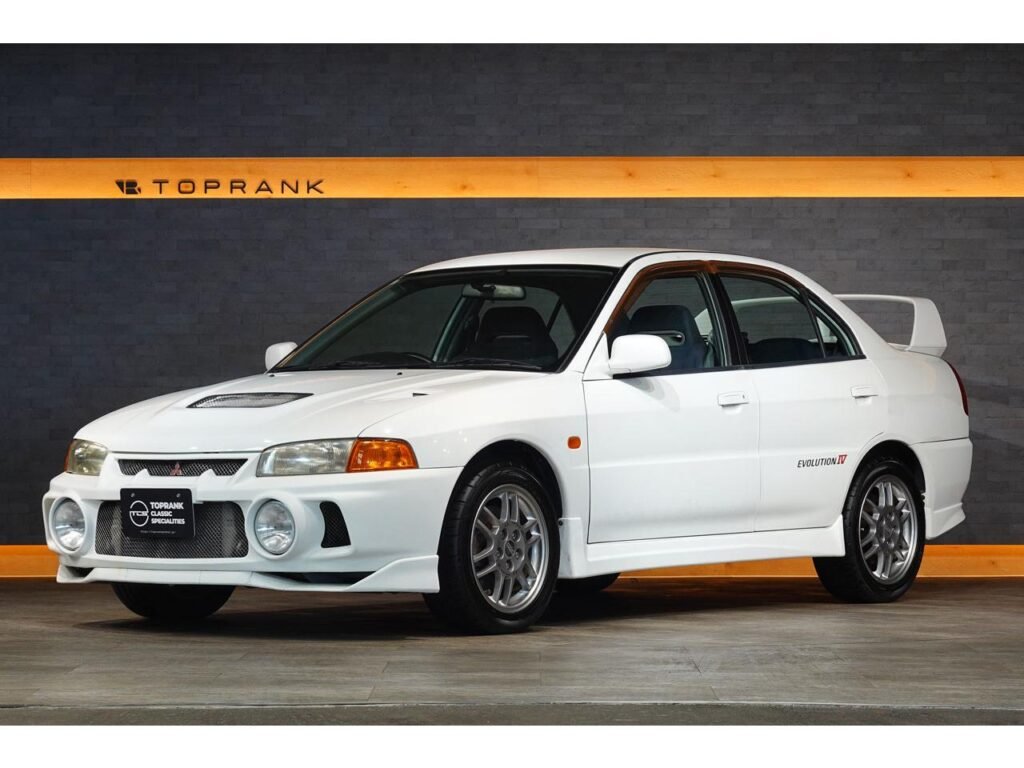
Where the Evo IV fits
Introduced in August 1996, the Evolution IV followed the redesigned Lancer onto a new platform. Mitsubishi changed the orientation of the 4G63 turbo engine by 180 degrees and redesigned the four-wheel-drive hardware. This was a substantial engineering change within a familiar four-door format.
The road car belongs to the CN9A generation. For a prospective buyer, that model code is more useful than a seller’s broad “Evo” description: bodywork, engine installations and drivetrain parts can have been changed during the car’s life. Compare the chassis identification with the documents before evaluating upgrades.
The road-car specification and AYC
Mitsubishi’s historical record gives the intercooled 2.0-litre 4G63 a rated output of 280 PS, with a twin-scroll turbocharger. PS is metric horsepower; it should not be relabelled as an identical bhp figure. The car measures 1,690 mm wide.
Active Yaw Control manages the difference in driving force between the rear wheels to influence the car’s rotation in a corner. For an AYC-equipped GSR, inspection should cover the system’s operation and service history as well as the engine. Ask about warning lights, fluid changes and repairs; an attractive engine bay gives little information about the condition of the rear drivetrain.
RS and GSR: choose by use
Mitsubishi positioned the RS as the competition-oriented base and the GSR as the more fully equipped road model. Its archive also records close-ratio gearing choices for the RS. These distinctions matter when comparing two apparently similar cars.
Request a description of the equipment actually fitted: differentials, gearbox, seats, wheels, air conditioning and any motorsport modifications. A previous owner may have changed the original configuration. Decide whether your priority is a preserved road car, period modifications or a documented competition history before setting the search criteria.
Rally history and the move to Evo V
Tommi Mäkinen won the 1997 drivers’ championship with the Group A Evolution IV programme, taking victories in Portugal, Catalunya, Argentina and Finland. The rally car’s transmission and engine specification must be distinguished from those of the showroom model.
The Evolution V arrived in January 1998. Mitsubishi widened the production body to 1,770 mm as it developed its Group A car against rivals running World Rally Car regulations. The IV also competed during the opening part of the 1998 season. A rally photograph dated 1998 therefore does not automatically show an Evo V.
What to check before buying
- Identity and history: chassis details, registration documents, service invoices and evidence supporting the recorded mileage.
- Body and structure: clear photographs of the underside, sills, wheel housings, mounting points and repaired areas.
- Engine and cooling: a cold start, operating-temperature checks, fluid leaks and a documented account of any engine or turbo work.
- Drivetrain and chassis: gearbox operation, clutch engagement, differential behaviour, suspension condition and tyre consistency.
- Modifications: an itemised parts list, calibration details and invoices. Identify what would need attention for your intended use.
An auction sheet helps establish questions for inspection. It should be read alongside current photographs and supporting records, especially where the description of a repair or modification is unclear.
Plan an Evolution IV search
Specify RS or GSR, your intended road or competition use, acceptable modifications, destination country and total budget. For an existing advert, include the chassis details and maintenance information so the inspection can focus on the actual car.